How Milk Collection Centres Work in India — FAT Testing, Rates & Payments Explained
A milk collection centre — called a doodh sangrah kendra in Hindi — is the first commercial stop that raw milk makes after leaving the farm. Every morning and evening, farmers pour litres of effort into a stainless steel vessel at the centre; in return, they expect a fair rate, a printed slip, and a reliable payout at the end of the week or fortnight. Getting all three right, every single day, across dozens of suppliers — that is what running a collection centre actually means.
This guide walks through the full operating picture: where the centre sits in the dairy supply chain, what happens from the moment milk arrives to the moment money reaches a farmer's hand, how the centre earns its margin, and what software does to remove the paper-slip chaos that ruins trust.
The Centre's Place in the Dairy Supply Chain
India's milk flows along a chain: smallholder farmer → collection centre → bulk cooler / chilling station → dairy plant or cooperative. The collection centre is the aggregation node. It does four things the dairy cannot do cheaply at farm level:
- Aggregates small volumes (often 5–50 litres per supplier) into a single bulk lot.
- Tests each supplier's milk for quality before it enters the bulk tank.
- Records quantity and quality data that become the basis for payment.
- Disburses cash or bank transfer to dozens of farmers, in one controlled cycle.
The dairy or cooperative gives the centre operator a price list that maps FAT percentage (and sometimes SNF) to a rupee-per-litre rate. The centre pays farmers according to this list, and the dairy pays the centre for the bulk lot. The difference — or a per-litre commission — is how the centre earns.
The Daily Routine: Morning Shift and Evening Shift
Collection centres run two shifts, mirroring cattle milking times.
Morning Shift (roughly 6 AM – 9 AM)
- Farmers arrive with milk in cans.
- The operator weighs each can (before and after pouring) using a calibrated digital platform scale.
- A sample — typically 15–20 ml — is drawn into a numbered sample bottle.
- The sample is analysed and the fat reading is logged against the supplier's ID.
- A slip is handed to the farmer: supplier name, date, shift, quantity (litres/kg), FAT%, and rate per litre.
- Milk enters the bulk tank or insulated can for pick-up by the dairy's tanker.
Evening Shift (roughly 4 PM – 7 PM)
Same process. Some centres weigh in kilograms and convert to litres using a fixed density factor (commonly 1.028–1.032 depending on fat content); others weigh directly in litres with a flowmeter.
The total across both shifts gives the day's pour — the quantity the dairy will invoice against.
FAT and SNF Testing: Gerber vs Electronic Analyser
The single most disputed number in a milk centre is the FAT reading. It directly determines the rate the farmer receives. Two methods are common:
Gerber Method (Wet Chemistry)
The Gerber test uses sulfuric acid and amyl alcohol in a butyrometer, centrifuged for a few minutes to separate fat. It is the legal reference standard. Equipment cost: ₹8,000–₹25,000 for a basic centrifuge setup. Reagents add ongoing cost of roughly ₹0.30–₹0.80 per sample. Skilled operators get ±0.1% accuracy. The limitation: it is slow — one batch takes 15–20 minutes — which creates a queue at busy morning shifts.
Electronic Milk Analyser (EMA)
Devices like Lactoscan, Milkotester, Milk-O-Scan, or domestic equivalents measure fat, SNF, density, protein, lactose, and added water in 30–60 seconds using ultrasound or infrared. Equipment cost: ₹35,000–₹1,80,000 depending on make, model, and parameters measured. No reagents, no centrifuge. Most medium and large centres have switched to EMAs. Calibration against the Gerber method must be done monthly, especially when seasons change (summer vs. monsoon milk composition shifts).
Dispute resolution tip: whenever a farmer challenges a reading, the best response is a fresh Gerber test on the retained sample. Retain a labelled 15 ml sample from every supplier for at least 24 hours. This one habit eliminates 90% of trust disputes.
Understanding the difference between the two parameters is essential — see our detailed explainer: What is FAT and SNF in milk — full guide in Hindi.

How Milk Is Priced: FAT-Based and FAT+SNF Two-Axis Rates
FAT-Only Pricing (Single-Axis)
The dairy publishes a base rate per litre at a standard FAT (commonly 6.0% for buffalo, 4.0% for cow). Every 0.1% fat above or below this standard adds or subtracts a fixed amount — typically ₹0.40–₹0.70 per 0.1% FAT per litre in most states, though the number varies by cooperative and region. This is the most common system at village centres.
Example: If the base rate is ₹700 per kg fat (or equivalently ₹7.00 per litre at 6.0% fat with a correction factor), and a farmer pours 10 litres at 6.4% fat:
- Fat content = 10 × 6.4/100 = 0.64 kg fat
- Payment = 0.64 × ₹700 = ₹448 for that pour
FAT + SNF Two-Axis Pricing
Better dairies price on both FAT and SNF (Solids-Not-Fat). SNF is everything in milk except fat and water — lactose, protein, minerals. A typical two-axis formula:
Rate per litre = (FAT × fat_rate_per_unit) + (SNF × snf_rate_per_unit) + base
For a worked example and the full formula, use the milk rate FAT/SNF calculator and the free online milk rate calculator.
How Total Solids (TS) Connects FAT and SNF
Total Solids = FAT + SNF. Some payment systems use TS directly. Read how Total Solids are calculated to understand the relationship between the three parameters.
How the Centre Earns Its Margin
A collection centre earns in one of two ways:
1. Per-litre commission from the dairy
The dairy pays the centre, say, ₹0.50–₹1.50 per litre collected, on top of the farmer payment. This is the clean model — no rate manipulation risk. On a centre collecting 500 litres per day, that is ₹250–₹750 per day, or ₹7,500–₹22,500 per month, before expenses.
2. Rate margin
The centre receives ₹X per litre from the dairy and pays the farmer ₹(X − margin) per litre. The margin must be disclosed in most cooperative frameworks. Abusing this model is a common source of farmer distrust.
Typical monthly P&L sketch (500 L/day centre):
| Item | Amount (₹/month) |
|---|
| Commission from dairy (₹1/L × 500L × 30) | 15,000 |
| Wages (1 operator or owner's labour cost) | 8,000 |
| Electricity, ice, consumables | 2,500 |
| Analyser servicing, reagents | 1,000 |
| Net operating surplus | ~3,500 |
At 1,000 L/day the surplus roughly doubles and becomes a viable standalone income. The business scales with volume — fixed costs are nearly constant once you have the equipment.
Thinking about how profitable a collection centre can be? Use the dairy profit calculator to model your own volumes and margins before you invest.
The Payment Cycle and the Reconciliation Headache
Farmers are typically paid weekly, every 10 days, or fortnightly — rarely daily. The reasons are practical: the dairy pays the centre in bulk (often 7–15 days after the pour), so the centre needs to hold working capital for a few days until it is reimbursed.
The manual reconciliation process looks like this:
- Operator collects daily slip carbons (or a notebook tally) for each supplier.
- At period end, sums up quantity and fat across all days for each supplier.
- Applies the rate table to get rupee amount per supplier.
- Cross-checks against any advances already paid.
- Calculates the net payout.
- Pays in cash, by cheque, or NEFT — and writes a receipt.
On paper, with 40 suppliers over a 10-day period, this is 400 rows of arithmetic, done after a long day of milk collection. Errors happen. When they do, a farmer discovers the discrepancy only at payout time — by which point trust is already fraying. The cycle of disputes is the single biggest operational drain on small centres.
What It Takes to Start a Milk Collection Centre
Starting a centre is within reach for an operator with the right dairy tie-up and a modest capital base. Here is a realistic checklist:
Regulatory and Tie-up Steps
- FSSAI Basic Registration (centres handling up to 100 kg/day) or State/Central Licence (above 100 kg/day). Fee: ₹100–₹7,500 depending on category.
- Agreement with a dairy, cooperative, or union — this is the most critical step. No tie-up, no sale. Approach your district dairy union, AMUL pattern cooperatives, or a private dairy plant. They will specify the price list, collection schedule, and quality norms.
- Local body registration / Gram Panchayat NOC if operating in a rented or panchayat space.
- GSTIN if annual turnover exceeds ₹20 lakh (lower for some states).
Equipment and Space
| Item | Approximate Cost (₹) |
|---|
| Electronic milk analyser (mid-range) | 60,000–1,20,000 |
| Digital platform scale (100 kg, NABL-verified) | 8,000–15,000 |
| Stainless steel bulk tank or insulated cans (500–1000 L) | 20,000–80,000 |
| Sample bottles, Gerber backup setup | 5,000–10,000 |
| Receipt/slip printer (thermal) | 3,000–6,000 |
| Covered space (own or rented, ~200 sq ft) | Variable |
Total equipment capital: ₹1–3 lakh for a basic 300–600 L/day centre.
Working Capital
You need enough float to pay farmers for one payment cycle (7–15 days) before the dairy reimburses you. For a 500 L/day centre at ₹30/L average, that is ₹1,05,000 to ₹2,25,000 of working capital. Many operators start with a cooperative that advances the payment, reducing this burden.
For a broader view of starting a dairy-adjacent business in India, read how to start a milk delivery business and the complete guide to dairy business in India.
Common Pitfalls and How to Avoid Them
1. Calculation disputes
A farmer gets ₹340 when he expected ₹370. Without a printed, signed slip at the point of collection, you cannot reconstruct what happened. Fix: always print a slip per pour; retain a carbon or digital copy. Never change a past entry without the farmer's acknowledgement.
2. Analyser calibration drift
EMAs drift over time, especially with temperature changes. A 0.2% FAT under-read translates to a real financial loss for the farmer. Fix: calibrate against Gerber monthly; log calibration date and reading. See milk adulteration and quality tests you can do yourself for hands-on testing methods.
3. Added-water disputes
When a farmer's milk tests 80% or more water on the SNF channel, the operator must reject the sample — but have a clear, written rejection policy. See the FAT/SNF dispute resolution tool for a reference on how to document and communicate rejections.
4. Advance loan entanglement
Many operators extend small advances to farmers, then deduct at payout. Without a proper ledger this becomes untrackable and creates resentment. Maintain a separate advance ledger per supplier.
5. No supplier visibility
Farmers who cannot see their own daily entries will always suspect under-recording. A supplier portal — where each farmer can view their own pours on their phone — is the most powerful trust-building feature a centre can offer.
How DudhHisaab Runs the Whole Centre
DudhHisaab App is designed from the ground up for exactly this operation — a single operator running dozens of supplier accounts across daily FAT-based rate calculations. Here is what the workflow looks like in the app:
Per-Supplier Ledgers
Every farmer gets their own account in the app. Each day's pour — morning and evening — is entered with quantity and FAT. The app calculates the rupee amount immediately using the rate table you configure.
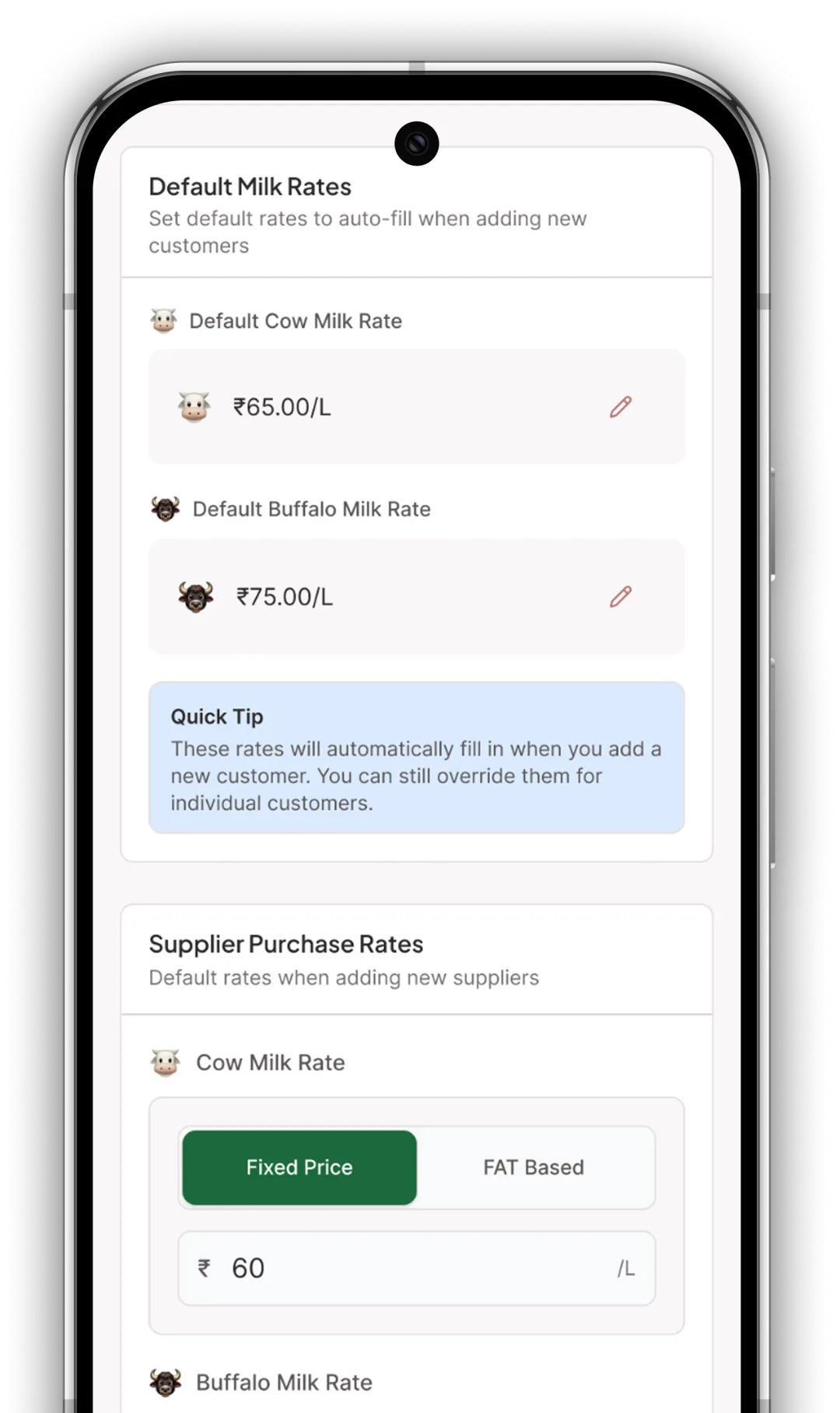
Automatic Rate Calculation
You set up your rate table once (FAT-based, or FAT+SNF two-axis). Every entry is priced automatically. No manual multiplication, no rate-book lookup. The calculation follows the same formula every time, so there is no room for human arithmetic error.
Period Statements and Payouts
At the end of your payment cycle — whether 7 days or 15 days — the app generates a period statement per supplier: every pour, FAT reading, calculated amount, any advance deducted, and the net payout. You can share it directly on WhatsApp or print it.
Supplier Portal
Each farmer gets access to a supplier portal where they can view their own daily entries, FAT readings, and payout history. This single feature converts "I don't trust your number" into "I can see it myself." Read more about how the supplier portal builds transparency in a collection centre: DudhHisaab supplier portal guide.
Integration with the Bigger Dairy Picture
If you run both a collection side and a delivery side — buying in bulk and retailing to households — the dairy farm management app guide explains how both halves connect in one account.
Running a collection centre on paper slips? DudhHisaab keeps every supplier's FAT entries, rate, and payout in one ledger and prints period statements automatically. Get the free Android app on Google Play →
Conclusion
A milk collection centre is a trust business. Farmers come back every morning and evening because they trust that their milk will be weighed accurately, their FAT read correctly, and their money paid on time. Break any one of those three promises and you will start losing suppliers within days — because the next centre is never far away.
The operators who run the best centres are not necessarily the ones with the most capital or the newest equipment. They are the ones who have the most reliable records — every pour, every FAT reading, every payout, available for any farmer to see at any time.
Paper slips were the only option for decades. They are not anymore.
For deeper reading: