How a Dairy Farm Owner Can Run the Whole Farm from One App

Running a dairy farm of even 10 to 20 animals is a full-time business. Between the morning milking shift, recording yield, setting rates for the collection centre, managing home-delivery customers, tracking feed costs, and following up on unpaid bills — most farm owners find themselves drowning in paper registers, mental notes, and WhatsApp messages that are impossible to trace a month later.
This guide is for the dairy farmer who wants to run a tighter, more profitable operation — not by working harder, but by finally seeing the whole picture in one place.
Note: DudhHisaab App is a business and records app. It handles milk, money, customers, suppliers and staff. It is not veterinary or animal-health software. If you need a tool to track animal diseases or breeding schedules, that sits outside this app's scope.
The Real Problems Every Dairy Farm Owner Faces
Before looking at any solution, it helps to name the actual pain points — the ones that cost money silently, day after day.
1. Daily Yield Goes Unrecorded — Or Gets Recorded Wrong
Most farms run two shifts: morning and evening. The morning milking happens at 5 AM when no one feels like writing in a register. By evening, the morning number is forgotten or mixed up. Over a month, the cumulative error can mean 50 to 100 litres of milk going unaccounted — which is real money leaving quietly.
2. Two Markets, Two Pricing Models — One Headache
Many farm owners sell to a milk collection centre at FAT-based rates (the more fat in the milk, the higher the rate per litre). They also sell directly to home delivery customers at a flat monthly rate. These are two completely different pricing models running simultaneously, and juggling them in a paper register is error-prone.
3. Feed Cost Eats the Margin — But No One Calculates It Daily
A cow or buffalo eating 10–12 kg of mixed feed per day costs ₹200–₹350 in feed alone. When milk output dips (post-peak lactation, illness, seasonal change), the margin collapses. Most farm owners feel this pain at month-end but cannot pinpoint when it started, or which animal caused it.
4. Payments Get Delayed or Lost
Home delivery customers are often neighbours or relatives. Asking for payment feels awkward. Without an automated monthly statement, the farm owner spends time doing mental arithmetic and chasing payments informally — and some months simply go unpaid.
5. Staff Work Is Invisible
A hired helper who does morning milking and delivery is essential — but tracking their attendance, daily delivery work, and output accountability is hard without a system. Most farm owners rely on memory.
How DudhHisaab Helps on the Selling Side
Recording Daily Milk — Shift by Shift
The app lets you log milk quantity in the morning and evening separately. You can record directly from your phone at the shed. Over time, this builds a month-by-month yield history per shift — so you can see whether output is dropping, and by how much.
For farms selling to a collection centre, the app supports FAT-based rate calculation. When you enter the FAT reading from the centre's milk-testing machine, the app calculates the exact payable amount at the correct rate slab. No more trusting the centre's printout blindly.
If you want to check what rate you should be getting before accepting a centre's offer, the milk rate calculator lets you verify it in seconds.
Managing Direct Home-Delivery Customers
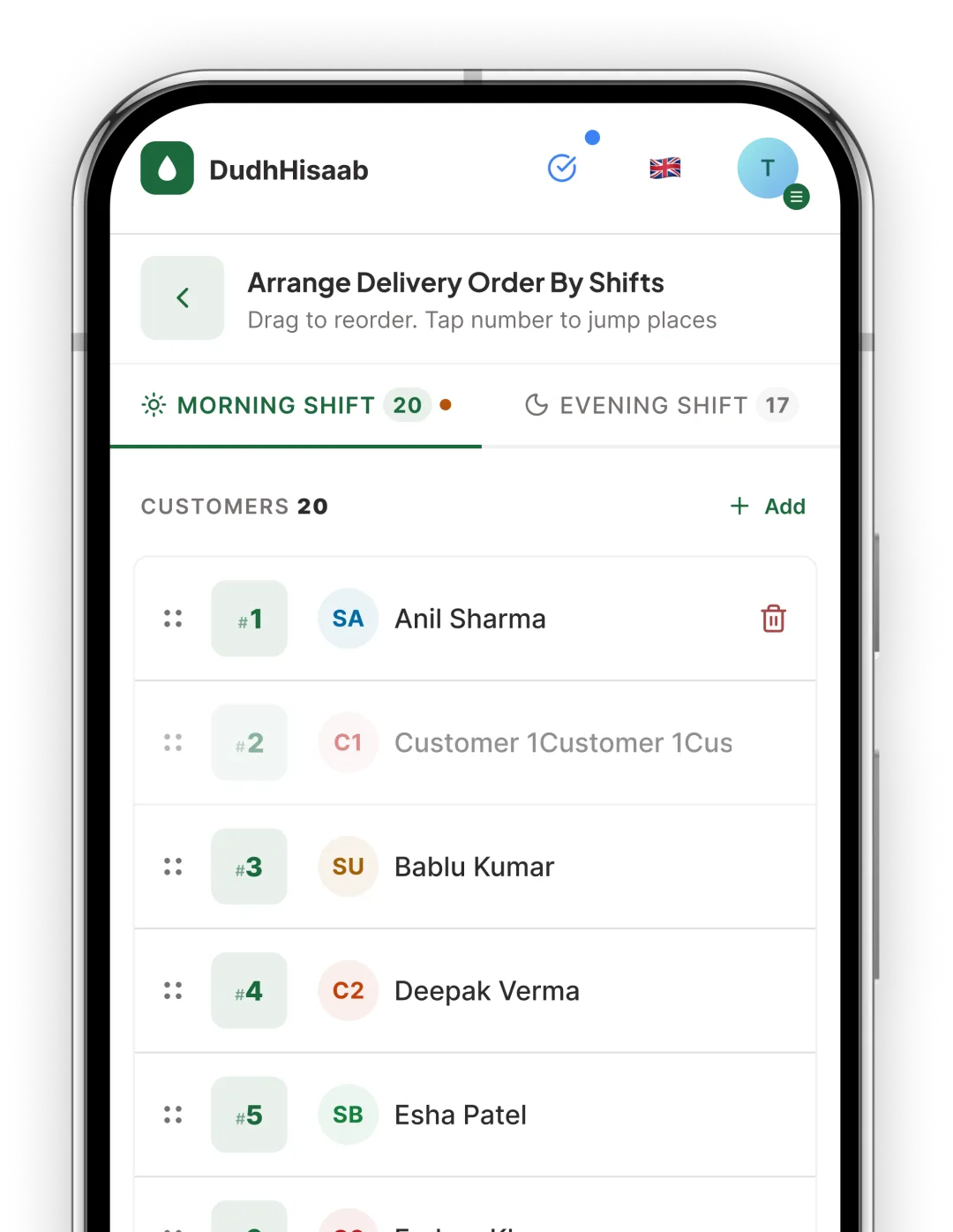
For customers who receive milk at home — say 2 litres every morning — DudhHisaab App tracks:
- Daily delivery quantity
- Monthly total
- Rate (fixed or variable)
- Generated monthly bill with exact totals
At the end of the month, you tap one button and the customer gets their statement on WhatsApp. No more guessing, no awkward conversations — just a clean bill that arrives automatically.
Read more about how monthly statements work in practice: Monthly Milk Bill & Statement for Customers.
Still sending handwritten bills to your milk customers every month? DudhHisaab auto-calculates totals, generates a clean statement and shares it on WhatsApp in one tap. Get it on Google Play →
Tracking Payments and Outstanding Balances
Each customer has a running ledger in the app. When a customer pays — fully or partially — you record it. The app shows exactly who owes how much. When payment reminders go out on WhatsApp, customers see their own statement, which reduces disputes.
If you want to grow beyond 20 home-delivery customers without losing track, see How to Scale Your Milk Business from 20 to 200 Customers.
The Buying Side: If You Also Collect Milk from Neighbours
Many farm owners don't just sell milk — they also buy milk from neighbouring small holders (2–3 buffalo owners nearby) and either sell it consolidated to the collection centre or to their own customers. This makes them both a seller and a collector.
DudhHisaab handles this too. You can add these local suppliers, record how much milk they deliver each day, and at month-end generate a payout statement showing exactly what you owe each supplier.
This is the same model that larger milk collection centres use, just at farm scale. You become a mini-aggregator — and the app treats you as one.
Profit & Cost View: Where Is the Money Actually Going?
This is the section most farm owners find most valuable — and most surprising.
Feed Cost vs. Milk Revenue
The app lets you record feed cost separately. When you compare feed cost for the month against total milk revenue, you see your raw margin. For a 10-cow farm:
| Metric | Example Value |
|---|
| Monthly milk revenue | ₹45,000 |
| Monthly feed cost | ₹28,000 |
| Gross margin | ₹17,000 |
| Other costs (labour, vet, misc.) | ₹5,000 |
| Net profit | ₹12,000 |
Most farm owners have never seen this table for their own farm. The profit calculator and feed cost calculator let you model different scenarios — what if you add 5 more animals? What if feed prices rise 10%?
Lactation Curves and Yield Trends
Milk output from a cow or buffalo peaks a few weeks after calving and then gradually declines over the lactation period. If you're recording yield daily, you can see this curve in your data. The lactation calculator helps you estimate how much yield you can expect over the full lactation — which helps with feeding decisions and purchasing decisions.
Per-Month Profit Tracking
The app shows month-over-month income, expense and profit. This is far more actionable than a single year-end calculation. If March was worse than February, you can investigate: did yield drop? Did a customer stop paying? Did feed prices spike?
For a deeper look at how successful dairy operations use data to grow, see Grow Your Dairy Business with Data-Driven Insights.
Staff and Delivery Tracking
If you have even one hired hand managing deliveries, the app helps you track:
- Which customer received milk today
- How many litres were delivered on each route
- Any customer who was skipped or short-delivered
This creates accountability without confrontation. If a customer claims they didn't receive milk on a particular day, the delivery record is in the app with a timestamp.
Staff attendance and payout tracking ensure that at month-end, calculating the helper's salary takes minutes rather than an argument.
Data Safety: Monthly Statements, WhatsApp Sharing, and Backup
Paper registers get wet, torn, lost in a fire, or simply become unreadable over time. A single register lost means months of business history gone.
DudhHisaab stores all data on your phone and backs it up automatically to Google Drive. Even if you lose or break your phone, you log in on a new device and your full history is there.
Learn how automatic backup works: Automatic Google Drive Backup for Dairy Data.
Monthly statements can be shared directly on WhatsApp — to customers, to your own accountant, or to a bank if you ever need to show income proof for a loan.
Paper registers can't back themselves up. DudhHisaab stores every milk record, payment and customer statement — and syncs to Google Drive automatically so nothing is ever lost. Get it free on Google Play →
A Day in the Life of a Farm Owner Using DudhHisaab
Let's walk through a realistic day for Ramesh, who runs a 25-animal farm (16 cows, 9 buffaloes) and sells to both a collection centre and 18 home-delivery customers.
5:30 AM — Morning Milking
Ramesh milks the animals with his helper. As each animal finishes, the helper notes the quantity on a small whiteboard at the shed. After milking, Ramesh opens the app and enters total morning yield: 210 litres.
He splits this: 160 litres will go to the collection centre's morning pickup; 50 litres will go to home-delivery customers.
7:00 AM — Home Deliveries
His helper loads the delivery cans. The app shows today's delivery list — 18 customers with their daily quantities. After deliveries, any shortage or extra is noted.
9:00 AM — Collection Centre Handover
The centre's representative collects the 160 litres and hands Ramesh a slip showing FAT reading: 6.8%. Ramesh enters this into the app. The app calculates the payable amount at today's rate slab and shows the total. He checks it against the centre's own figure — they match. He marks it received.
5:30 PM — Evening Milking
Same process. Evening yield: 185 litres. This goes entirely to the collection centre (home-delivery customers take morning milk only). He records it in the app.
8:00 PM — End of Day Review
Ramesh checks today's summary in the app:
- Total yield: 395 litres
- Revenue from collection centre: calculated from FAT readings
- Home deliveries: recorded
- Feed cost for the day: entered (approximate daily figure)
He notices one customer (Suresh, 2 litres/day) has a pending balance of ₹840 from last month. He sends a WhatsApp reminder from within the app — one tap.
Month-End (30th of the month)
Ramesh generates all 18 customer statements in the app. He sends them via WhatsApp. Within 48 hours, 15 of the 18 customers have paid. The remaining three he follows up with personally.
He also generates the supplier payout summary for the 3 neighbours whose milk he consolidates. He pays them and marks it done in the app.
He checks the month's profit: revenue minus feed cost minus helper salary. The number is clear. He compares it to last month. It's better. He can see why — yield was higher in the first two weeks.
How DudhHisaab Fits Into the Bigger Picture
A well-run dairy farm is actually several businesses layered together:
- Milk production (animals, feed, yield)
- Wholesale selling (collection centre, FAT-based pricing)
- Retail selling (home delivery, monthly billing)
- Sourcing (buying from neighbouring suppliers)
- Staff management (helpers, delivery, accountability)
No single paper register handles all five. DudhHisaab is built specifically for the business layer — tracking milk, money, customers and suppliers so the farm owner has a clear financial picture every single day.
For context on the broader dairy business landscape in India, the Complete Guide to Starting a Dairy Business in India covers how farms, collection centres and distributors fit together.
If you're evaluating whether cow or buffalo milk makes more business sense for your scale, see Cow vs Buffalo Milk: Which Is More Profitable?
And if you want to understand FAT and SNF readings in depth — what they mean and how they affect your rate — Total Solids (TS) and Milk Quality Calculation is a good read.
Getting Started Takes Less Than 10 Minutes
You don't need to set up everything at once. Most farm owners start by doing just two things:
- Adding their home-delivery customers and recording today's morning delivery
- Logging today's collection centre quantity and FAT reading
That's it for day one. Within a week, you have a full picture of your daily yield and delivery pattern. Within a month, you have enough data to see your profit clearly for the first time.
The app is free, works in Hindi and English, and doesn't require any technical knowledge. If you can send a WhatsApp message, you can use DudhHisaab.
DudhHisaab is a milk business records app used by dairy farm owners, collection centres and distributors across India. It is not veterinary software and does not track animal health or breeding records.