What Are Total Solids (TS) in Milk — and Why Do They Matter?
When a dairy farmer or collection-centre operator talks about "good milk," they are really talking about milk that is dense with useful solids. Total Solids (TS) is the single number that captures that density.
TS = FAT% + SNF%
That is the complete formula. TS is the sum of the fat percentage and the Solids-Not-Fat (SNF) percentage of a given milk sample. Everything else — water — is subtracted away.
Why does TS matter?
- Buyers pay for solids, not water. A litre of milk that is 30% water and 70% solids is worth more than a litre that is 50% water.
- Processing yield. Paneer, ghee, khoa, and butter yields all scale with TS. Dairies track TS to predict how many kilograms of product they will recover from a given batch.
- Quality comparison. Two suppliers delivering the same volume may deliver very different quantities of actual value. TS makes that comparison objective.
- Legal compliance. FSSAI prescribes minimum FAT and SNF levels, which together define a minimum TS floor (see the section on FSSAI minimums below).
Before calculating TS, you need reliable FAT and SNF values. If you have not already read our primer on what these two numbers mean and how they are measured, start with FAT and SNF in milk — a complete guide and then return here.

Step-by-Step TS Calculation — Worked Examples
Example 1: Cow Milk
A dairy farmer brings cow milk with:
TS = 3.8 + 8.6 = 12.4%
In a one-litre sample weighing roughly 1,030 g, the actual solids present are approximately 127.7 g. That is the real value being traded.
Example 2: Buffalo Milk
Buffalo milk typically carries higher values:
TS = 7.2 + 9.4 = 16.6%
In the same one-litre sample (buffalo milk is denser, ~1,032 g), the solids are approximately 171.3 g — nearly 34% more than the cow-milk example above.
Use the calculator below to work out the TS for any sample instantly:
Try it yourself — Total Solids calculator
Full tool: FAT-SNF Rate Calculator · save entries in the app
Deriving SNF When You Only Have a Lactometer and FAT
Many small collection centres do not own a milk analyser. They use a lactometer (which gives Corrected Lactometer Reading, or CLR) and a Gerber or digital FAT meter. From these two measurements, SNF can be estimated using the Richmond formula:
SNF% = (CLR divided by 4) + (0.21 multiplied by FAT%) + 0.36
Where CLR is the reading on the lactometer scale (a unitless number, typically between 26 and 34 for genuine milk).
- Lactometer reading at 27°C: CLR = 29
- FAT = 4.2%
SNF = (29 / 4) + (0.21 × 4.2) + 0.36
SNF = 7.25 + 0.882 + 0.36
SNF ≈ 8.49%
Then: TS = FAT + SNF = 4.2 + 8.49 = 12.69%
Temperature Correction
The Richmond formula is calibrated for milk at 27°C (standard Indian room temperature). If the milk sample is at a different temperature, apply this correction before using the CLR value:
- For every 1°C above 27°C, add 0.2 to the CLR reading.
- For every 1°C below 27°C, subtract 0.2 from the CLR reading.
Example: Lactometer reads 28 but milk is at 31°C (4°C above standard).
Corrected CLR = 28 + (4 × 0.2) = 28 + 0.8 = 28.8
Then proceed with 28.8 in the Richmond formula. Skipping this step on a hot summer day can underestimate SNF by 0.4–0.6 percentage points and cost a farmer a meaningful amount on every delivery.
Spending time on manual corrections for every supplier? DudhHisaab stores each supplier's FAT, SNF, and TS automatically and calculates their per-litre rate without any manual arithmetic. Get the free Android app on Google Play →
TS-Based Pricing Methods Used Across India
Once you have TS (or FAT and SNF separately), you can apply one of several pricing methods. Understanding each method helps both farmers and collection-centre operators negotiate fairly. Our milk rate calculator tool supports all four methods described below.
For a deep dive into how rates are set and compared, see Milk rate calculation from FAT and SNF.
Try it yourself — free calculator
Full tool: FAT-SNF Rate Calculator · save entries in the app
Method 1 — Flat Rate per TS Unit
The simplest approach. A fixed price is set per percentage point of TS.
Example:
- Rate agreed: ₹6.50 per TS unit per litre
- Milk TS = 13.0%
- Rate per litre = 13.0 × ₹6.50 = ₹84.50
This method is easy to explain to farmers, but it treats FAT and SNF as equally valuable — which they are not always, since FAT commands a premium in most markets.
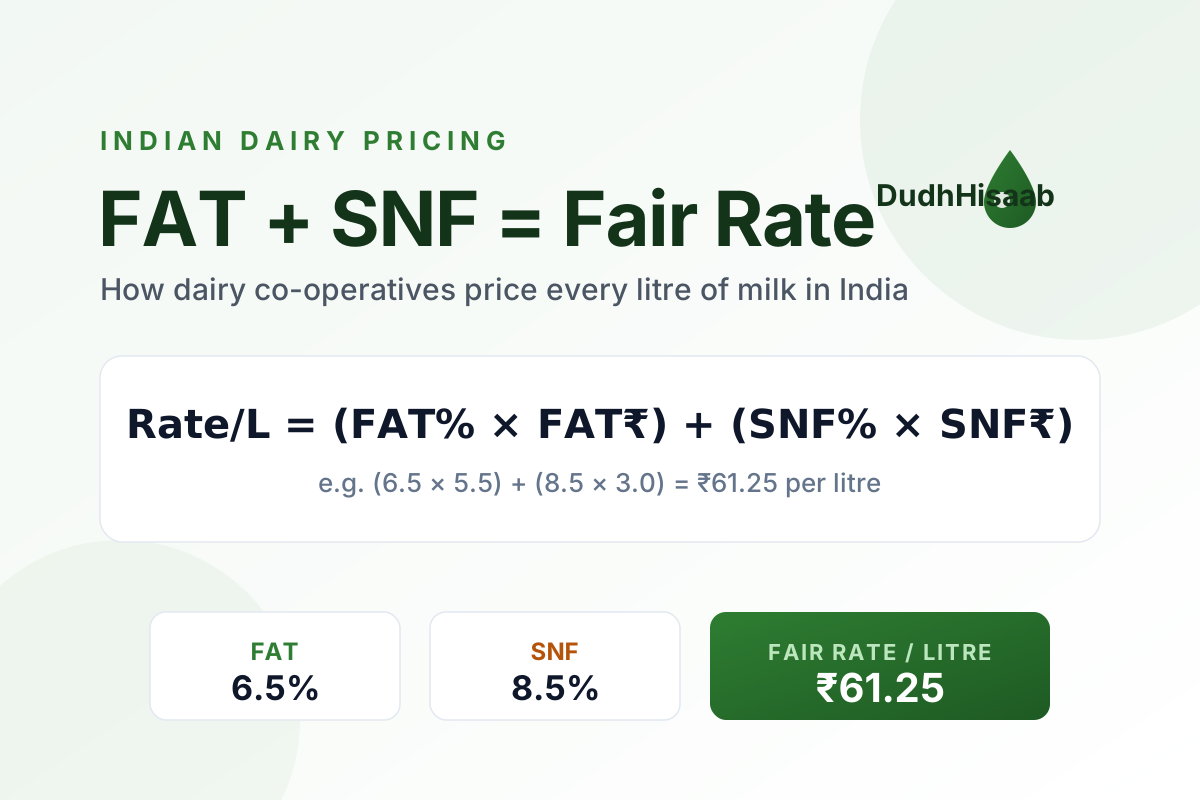
Method 2 — Two-Axis FAT + SNF (Amul-Style)
Separate rates are set for FAT and SNF. The per-litre price is:
Price = (FAT% × Rate-per-FAT) + (SNF% × Rate-per-SNF)
Example (typical cooperative values; actual rates vary by state and season):
- FAT rate: ₹5.50 per unit per litre
- SNF rate: ₹2.00 per unit per litre
- Milk: FAT 4.5%, SNF 8.8%
Price = (4.5 × 5.50) + (8.8 × 2.00)
Price = ₹24.75 + ₹17.60
Price per litre = ₹42.35
This method is used by most large cooperatives because it correctly rewards the higher-value component (fat) more than SNF.
Method 3 — Per-kg FAT / Per-kg SNF
Instead of percentage points, buyers pay per kilogram of fat and SNF actually delivered. This is common in bulk tanker procurement.
Example:
- Milk volume: 100 litres, density ≈ 1.030 kg/L → weight = 103 kg
- FAT = 4.0% → kg FAT delivered = 103 × 0.04 = 4.12 kg
- SNF = 8.6% → kg SNF delivered = 103 × 0.086 = 8.86 kg
- Rate: ₹350 per kg FAT, ₹60 per kg SNF
Payment = (4.12 × 350) + (8.86 × 60)
Payment = ₹1,442 + ₹531.60
Total payment = ₹1,973.60 for 100 litres = ₹19.74 per litre
This method is mathematically the most accurate but requires precise weighing at the collection point.
Method 4 — Fixed Rate per Litre
Some small centres still pay a flat rupee-per-litre regardless of quality. This is the least fair method: a farmer delivering high-TS buffalo milk earns the same as one delivering diluted or low-TS cow milk.
Example: ₹38 per litre, irrespective of FAT or SNF.
Fixed rates are declining as digital collection systems and affordable analysers make quality-based pricing accessible even to small operators. If you run a collection centre, read how milk collection centres work for a fuller picture of why quality-linked pricing improves farmer trust and long-term supply quality.
FSSAI Legal Minimums for FAT and SNF
The Food Safety and Standards Authority of India (FSSAI) prescribes minimum standards under the Food Safety and Standards (Food Products Standards and Food Additives) Regulations, 2011. The widely cited all-India minimums are:
| Milk Type | Minimum FAT% | Minimum SNF% | Implied Minimum TS% |
|---|
| Cow milk | 3.5 | 8.5 | 12.0 |
| Buffalo milk | 6.0 | 9.0 | 15.0 |
| Goat / Sheep milk | 3.0 | 8.5 | 11.5 |
| Standardised milk | 4.5 | 8.5 | 13.0 |
| Toned milk | 3.0 | 8.5 | 11.5 |
| Double-toned milk | 1.5 | 9.0 | 10.5 |
Important: Several Indian states (including Maharashtra, Gujarat, and Rajasthan) have notified standards that are stricter than the central FSSAI minimums. Always verify the applicable state regulation for your procurement zone. The table above reflects typical central minimums; your local FSSAI office or NDDB representative can confirm the state-specific values.
Milk falling below these minimums cannot legally be sold as milk in India. Collection centres that accept substandard milk expose themselves to legal liability and downstream rejection by dairies. For a practical guide to spotting adulteration before it reaches your centre, see milk adulteration tests you can do at home.
Typical TS Ranges — Cow vs Buffalo

Understanding typical ranges helps you identify outlier samples quickly.
| Parameter | Cow Milk (range) | Buffalo Milk (range) |
|---|
| FAT% | 3.2 – 5.5 | 5.5 – 9.0 |
| SNF% | 8.2 – 9.0 | 8.8 – 10.2 |
| TS% | 11.5 – 14.5 | 14.5 – 19.0 |
| Water% | 85.5 – 88.5 | 81.0 – 85.5 |
These ranges are for pure, unadulterated milk from healthy animals. A TS below 11.0 in cow milk or below 14.0 in buffalo milk should prompt a retest and possibly a refusal.
For a side-by-side business comparison of cow and buffalo milk — including typical yield from ghee and paneer — read Cow vs buffalo milk: which is more profitable?
How to Improve TS in Milk
If your suppliers are consistently delivering low-TS milk, the following agronomic interventions tend to help:
- Balanced feed ration. Include adequate green fodder, dry fodder, and concentrate feed. Protein and energy deficits directly reduce SNF.
- Mineral supplementation. Calcium, phosphorus, and magnesium deficiencies are common in Indian dairy herds and suppress both FAT and SNF.
- Complete milking. Foremilk is watery and low in fat; hindmilk is richest. Incomplete milking skews the delivered sample toward lower FAT and therefore lower TS.
- Breed selection. Murrah and Nili-Ravi buffaloes consistently produce higher TS than Bhadawari; HF crossbreds produce higher volumes but lower fat than Sahiwal or Gir.
- Health management. Sub-clinical mastitis is a leading cause of SNF depression. Regular somatic-cell-count (SCC) testing allows early detection.
- Water access. Dehydrated animals produce concentrated but lower-volume milk; the apparent TS may look acceptable but yield is suppressed. Ensure ad libitum water access.
For a broader view of running a profitable dairy operation, see the complete guide to starting a dairy business in India.
TS Quick-Reference Chart
The table below shows representative samples across common FAT and SNF combinations, with indicative rates under a two-axis pricing scheme (FAT rate: ₹5.50 / unit, SNF rate: ₹2.00 / unit). Actual rates in your area will differ — use this only to understand the relative impact of TS on payment.
| FAT% | SNF% | TS% | Indicative Rate (₹/L) |
|---|
| 3.5 | 8.5 | 12.0 | ₹36.25 |
| 4.0 | 8.7 | 12.7 | ₹39.40 |
| 4.5 | 8.9 | 13.4 | ₹42.55 |
| 5.0 | 9.0 | 14.0 | ₹45.50 |
| 6.0 | 9.2 | 15.2 | ₹51.40 |
| 7.0 | 9.5 | 16.5 | ₹57.50 |
| 7.5 | 9.8 | 17.3 | ₹60.85 |
| 8.0 | 10.0 | 18.0 | ₹64.00 |
Rates calculated as: (FAT × 5.50) + (SNF × 2.00). For fat-SNF disputes at your centre, the FAT-SNF dispute tool can help document and resolve disagreements.
How DudhHisaab Removes the Manual Maths
Every calculation in this article — TS from FAT and SNF, the Richmond formula, temperature-corrected CLR, per-litre price under any of the four pricing methods — happens automatically inside the DudhHisaab app every time a delivery is recorded.
You enter the FAT and SNF (or connect an RFID analyser); the app computes TS, calculates the rate according to your configured price slab, adds the entry to the supplier's running ledger, and updates their monthly statement — all in seconds.
Collection centres using DudhHisaab App also get:
- Morning and evening shift summaries with average FAT, SNF, and TS
- Per-supplier quality trend charts so you can spot a declining animal or a dilution pattern early
- Automatic SMS and WhatsApp payment summaries to farmers
- A profit calculator that shows your net margin after input costs
Still writing FAT and SNF readings in a register and calculating rates by hand? Thousands of collection centres across India have switched to DudhHisaab. It is free to start. Download it on Google Play →
For a full walkthrough of setting up the app for your dairy or collection centre, see the dairy farm management app guide.
Summary
- TS = FAT% + SNF%. It is the total useful content in milk, and it is what buyers ultimately pay for.
- When you only have a lactometer and FAT meter, use the Richmond formula: SNF = (CLR / 4) + (0.21 × FAT) + 0.36, with a temperature correction of ±0.2 per °C from 27°C.
- India uses four main pricing methods: flat TS rate, two-axis FAT+SNF, per-kg fat/SNF, and fixed rate. Two-axis is the most common for formal procurement.
- FSSAI minimums: cow milk FAT ≥ 3.5%, SNF ≥ 8.5%; buffalo milk FAT ≥ 6.0%, SNF ≥ 9.0%.
- Low TS can be improved through balanced feed, mineral supplementation, complete milking, and mastitis control.
- DudhHisaab automates all of this arithmetic so you can focus on running your business.