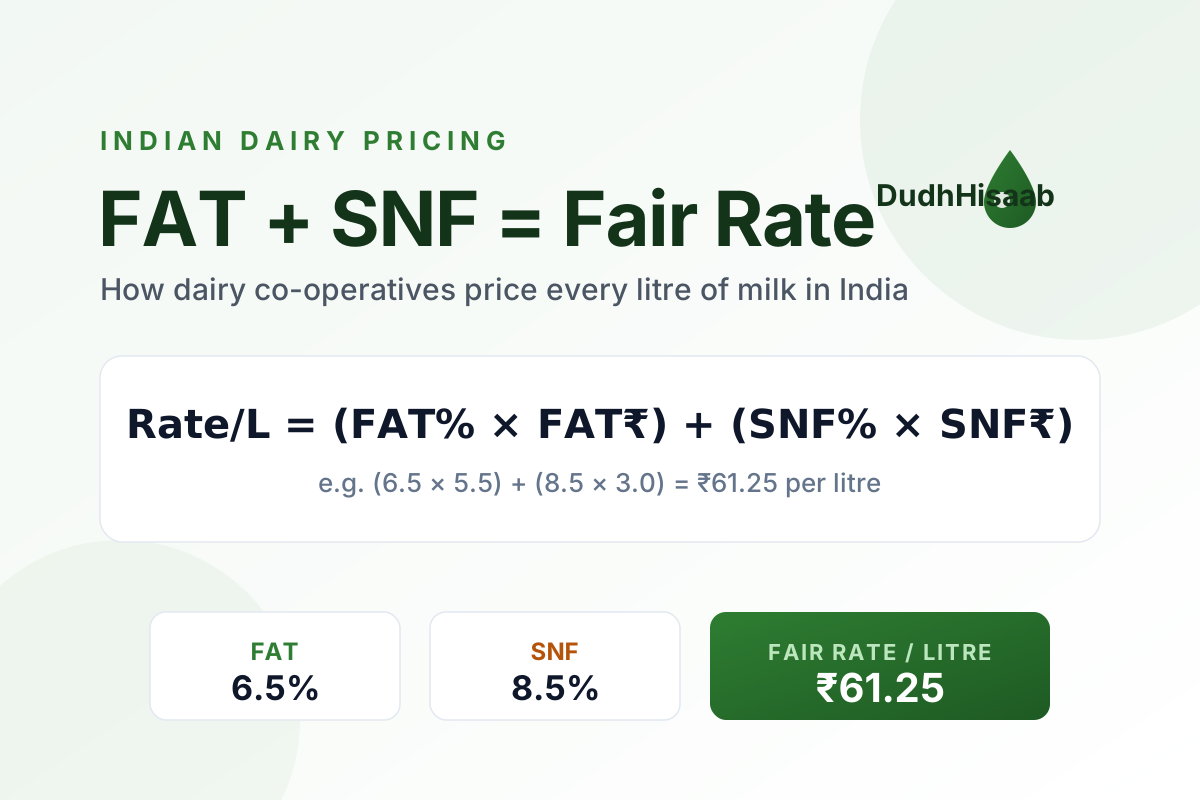
What Are FAT and SNF in Milk?
If you buy or sell milk through a dairy cooperative, a collection centre, or directly from farmers, two numbers decide what you pay and what you earn: FAT and SNF. Price them right and every litre is fair. Get them wrong — or let someone else do the maths for you — and you quietly lose money on each delivery.
Here is exactly what the two terms mean and how the rate is worked out.
FAT (Fat Content) is the percentage of fat in the milk. More fat means richer, creamier milk and a higher rate. Buffalo milk usually carries 6–8% fat; cow milk sits around 3.5–5%.
SNF stands for Solids-Not-Fat — everything solid in milk except the fat: proteins (casein and whey), lactose (milk sugar), minerals and vitamins. In short, SNF in milk is its nutritional backbone. Cow milk normally carries 8.3–8.7% SNF and buffalo milk 9–10%; the FSSAI legal minimum is 8.5% SNF for cow milk and 9.0% for buffalo milk in most states. A higher SNF means more nutrition per litre — and a higher rate at the collection centre.
Add FAT and SNF together and you get the Total Solids (TS): TS = FAT + SNF. The more total solids, the more the milk is worth. For a deep dive — every TS pricing variation, the lactometer-to-SNF formula and a ready reckoner chart — read our full guide to calculating TS from FAT and SNF.
Tracking FAT for several suppliers by hand? DudhHisaab stores each supplier's rate and works out the per-litre price from the day's FAT automatically. Get the free Android app on Google Play →
How Is Milk Rate Calculated?
Four methods are in common use across India. Match the one your dairy or cooperative actually follows.
Method 1 — FAT-Based Pricing (most common for individual doodhwalas)
The simplest method, used by most small dairies and many cooperatives:
Rate per litre = FAT% × Rate per FAT unit
Worked example:
- Milk FAT: 6.5%
- Rate per FAT unit (set by the cooperative): ₹8.50
- Rate per litre = 6.5 × 8.50 = ₹55.25
The rate per FAT unit moves with the market and is usually fixed by the dairy or cooperative. In 2026, typical rates are:
- Buffalo milk: ₹7.50–9.00 per FAT unit
- Cow milk: ₹8.00–10.00 per FAT unit (higher per unit because the fat is lower)
Method 2 — Two-Axis Pricing (FAT + SNF)
Used by most large cooperatives — Amul, Karnataka Milk Federation and the like:
Rate = (FAT% × FAT rate) + (SNF% × SNF rate)
Worked example:
- Milk FAT: 4.0%, SNF: 8.5%
- FAT rate: ₹7.00 per unit, SNF rate: ₹3.50 per unit
- Rate = (4.0 × 7.00) + (8.5 × 3.50) = 28.00 + 29.75 = ₹57.75 per litre
This is the fairest method, because it pays for both fat and nutritional quality. A farmer whose cow milk is low in fat but high in SNF still earns a good rate. Plug any FAT and SNF into our free milk rate calculator to see the per-litre rate instantly.
Method 3 — TS Rate Calculation (Total Solids Pricing)
Rate = Total Solids% × Rate per TS unit, where Total Solids = FAT + SNF.
Worked example:
- FAT: 6.0%, SNF: 9.0%, TS: 15.0%
- Rate per TS unit: ₹4.00
- Rate = 15.0 × 4.00 = ₹60.00 per litre
Drag in your own FAT and SNF to see your Total Solids and the TS-based rate instantly:
Try it yourself — Total Solids calculator
Full tool: FAT-SNF Rate Calculator · save entries in the app
Method 4 — Fixed Rate (most small doodhwalas)
Many milkmen simply agree a flat rate per litre with each customer:
- Gaay ka doodh (cow): ₹55–70/litre, depending on the city
- Bhains ka doodh (buffalo): ₹70–90/litre
No FAT/SNF testing is involved — the rate rests on trust, local market rates and mutual agreement. Choosing between the two animals first? Compare the economics in cow vs buffalo milk business profit.
Try it yourself — free calculator
Full tool: FAT-SNF Rate Calculator · save entries in the app
How to Test FAT and SNF
Testing FAT
- Gerber method — the standard at collection centres. Needs a Gerber centrifuge (₹3,000–8,000), a butyrometer and sulphuric acid.
- Electronic milk analyser — machines such as Lactoscan or Milkotester give instant FAT, SNF and other readings. A basic unit costs ₹15,000–50,000.
Calculating SNF
You can derive SNF from the FAT% and a lactometer reading:
SNF% = (Lactometer Reading ÷ 4) + (0.21 × FAT%) + 0.36
This is the Richmond-formula variation used across Indian dairies. You need:
- A lactometer (₹200–500) to measure milk density
- The FAT% from the test above
Worked example:
- Lactometer reading: 30 (at 27°C, corrected)
- FAT%: 5.0
- SNF = (30 ÷ 4) + (0.21 × 5.0) + 0.36 = 7.5 + 1.05 + 0.36 = 8.91%
Correcting for temperature
Lactometer readings must be corrected for temperature. The standard is 27°C (some states use 20°C):
- For every 1°C above standard: add 0.2 to the reading
- For every 1°C below standard: subtract 0.2 from the reading
Milk FAT SNF Rate Chart 2026 (Buffalo and Cow)
These ready-reference charts use typical 2026 cooperative rates. Your union's exact per-unit rate will differ slightly — the structure is what matters.
Buffalo milk fat rate chart 2026 (at ₹8.00 per FAT unit):
| FAT% | Rate/Litre |
|---|
| 5.0 | ₹40.00 |
| 5.5 | ₹44.00 |
| 6.0 | ₹48.00 |
| 6.5 | ₹52.00 |
| 7.0 | ₹56.00 |
| 7.5 | ₹60.00 |
| 8.0 | ₹64.00 |
| 8.5 | ₹68.00 |
Cow milk fat rate chart 2026 (at ₹9.50 per FAT unit):
| FAT% | Rate/Litre |
|---|
| 3.0 | ₹28.50 |
| 3.5 | ₹33.25 |
| 4.0 | ₹38.00 |
| 4.5 | ₹42.75 |
| 5.0 | ₹47.50 |
| 5.5 | ₹52.25 |
Two-axis FAT + SNF rate chart 2026 (at ₹7.00 per FAT unit + ₹3.50 per SNF unit — the Amul-style structure):
| FAT% ↓ / SNF% → | 8.0 | 8.5 | 9.0 | 9.5 |
|---|
| 3.5 | ₹52.50 | ₹54.25 | ₹56.00 | ₹57.75 |
| 4.0 | ₹56.00 | ₹57.75 | ₹59.50 | ₹61.25 |
| 4.5 | ₹59.50 | ₹61.25 | ₹63.00 | ₹64.75 |
| 5.0 | ₹63.00 | ₹64.75 | ₹66.50 | ₹68.25 |
| 6.0 | ₹70.00 | ₹71.75 | ₹73.50 | ₹75.25 |
| 7.0 | ₹77.00 | ₹78.75 | ₹80.50 | ₹82.25 |
| 8.0 | ₹84.00 | ₹85.75 | ₹87.50 | ₹89.25 |
Looking for the Amul or Saras fat rate list 2026 PDF? Those official rate circulars are issued by each union to its member societies and change several times a year — there is no single public PDF that stays current. Ask your society secretary for the latest circular, or use the chart logic above with your union's current per-unit rates. For consumer-side market rates across India, see our live milk price heatmap for 62 cities.
Don't want to read a chart every morning? Enter the day's FAT in DudhHisaab and it shows the per-litre rate and the supplier's running monthly total instantly. Download DudhHisaab free on Google Play →
What a 0.5% FAT Drop Really Costs You
It is easy to wave off "half a percent" of FAT. The arithmetic says otherwise — and this is exactly where most doodhwalas quietly lose money without ever seeing it on a bill.
Take a typical mid-size supplier — call him Ramesh, who collects about 60 litres of buffalo milk a day near Mehsana and sells to the local cooperative at ₹8 per FAT unit. Through spring his FAT held steady at 6.8%. By peak summer — green fodder short, animals heat-stressed — it slid to 6.3%, a drop of just 0.5%. Nobody flagged it; the litres on the slip looked the same as always.
That half-percent cost him 0.5 × ₹8 = ₹4 per litre. On 60 litres that is ₹240 a day — about ₹7,200 over the month, gone, on milk he worked just as hard to produce. He only caught it when his month-end payout came up short and he scrolled back through his daily FAT readings and saw the slide.
Half a percent of FAT, on 60 litres, at ₹8 a unit, is ₹7,200 a month. That is not a rounding error — it is a phone bill, a school fee, a real piece of your profit.
Put your own numbers in below and see what a drop on your milk is actually worth:
How much is a FAT drop costing you?
DudhHisaab records every supplier’s FAT daily, so a quiet drop like this shows up the same day — not at month-end. Track FAT free on Google Play
The lesson is not "panic over every reading" — it is that FAT moves quietly, and the only real defence is recording it every single day so a slide shows up in days, not at month-end. That is exactly what the daily FAT log in DudhHisaab is for. To see where in the chain those readings are taken and how they turn into your payout, read how milk collection centres actually work — and to avoid the other money-leaks on the payments side, see the common mistakes milk suppliers make with customer payments.
How to Increase SNF in Milk
Since every 0.5% of SNF moves the rate by ₹1.50–2.00 per litre under two-axis pricing, raising SNF is real money. SNF comes from the animal's nutrition and health, so the levers are management, not tricks:
- Balance the ration. SNF is mostly protein and lactose, which need energy and protein in the feed. Feed a proper concentrate mix (16–18% crude protein) alongside green and dry fodder — underfed animals give thin, low-SNF milk.
- Add a mineral mixture daily. 50–60 g of a good mineral mixture per animal per day is the single cheapest SNF booster — calcium, phosphorus and trace minerals directly support milk solids.
- Feed bypass protein / oilseed cake. Cottonseed, mustard or groundnut cake raises both FAT and SNF. Bypass-protein feeds work especially well in high-yielding animals.
- Keep clean, unlimited drinking water. Dehydrated animals give less milk and lower solids. Yet never add water to milk — that crashes SNF instantly and the lactometer catches it.
- Deworm and treat mastitis early. Parasites and sub-clinical mastitis quietly pull SNF down by 0.3–0.5%. Regular deworming (every 3–4 months) and udder hygiene protect your solids.
- Mind the season. SNF dips in peak summer from heat stress. Shade, fans and early-morning feeding limit the drop.
Genetics set the ceiling — a Jersey-cross or Murrah buffalo will always out-solid a poor crossbred — but feeding and health decide how close to that ceiling the animal performs. Expect visible SNF improvement in 2–3 weeks after fixing the ration.
State-Wise Milk Rates: What Major Cooperatives Pay
Procurement rates are fixed by each milk union and revised through the year, so treat the figures below as indicative 2026 ranges, not today's exact rate sheet — always confirm with your own society before quoting a price.
| Cooperative / Region | Pricing basis | Indicative procurement payout |
|---|
| Amul / GCMMF (Gujarat) | FAT + SNF (two-axis) | ₹38–48 per litre at ~6.5% FAT buffalo |
| Nandini / KMF (Karnataka) | FAT + SNF + state incentive | ₹33–42 per litre + govt top-up |
| Saras (Rajasthan) | FAT-based, cow & buffalo slabs | ₹40–55 per litre buffalo |
| Aavin (Tamil Nadu) | FAT + SNF (two-axis) | ₹34–40 per litre cow |
| Sudha (Bihar) | FAT-based | ₹35–46 per litre buffalo |
| Mother Dairy / private dairies | FAT + SNF or contract rate | Varies by region and agreement |
The pattern is the same everywhere: richer milk (higher FAT and SNF) earns more, and most large unions add a small seasonal or quality incentive on top. Several state governments also pay a per-litre subsidy straight to the farmer, which is separate from the dairy's FAT-SNF payout.
Common Problems with FAT-Based Pricing
- Milk adulteration. Adding water lowers the FAT%, which is why collection centres test every batch. If you buy from farmers, keep at least a lactometer (₹200) on hand to check density — and learn the simple milk adulteration tests you can run at home to catch water, starch and detergent.
- Seasonal variation. FAT moves with the season — buffalo fat peaks in winter (7–8%) and dips in summer (5.5–6.5%). Your buying costs will swing, so plan for it.
- Disputes over testing. Different machines read slightly differently. Use calibrated equipment and service it regularly.
- Mixed-milk complications. Buying from several farmers with different FAT levels means tracking each supplier separately and working out weighted averages — slow and error-prone on paper.
Track FAT and Rates Automatically with DudhHisaab
DudhHisaab App is a free Android app built for running a milk business in India. Instead of a paper khata and a calculator, you set each supplier's pricing once and the app does the maths every single day.
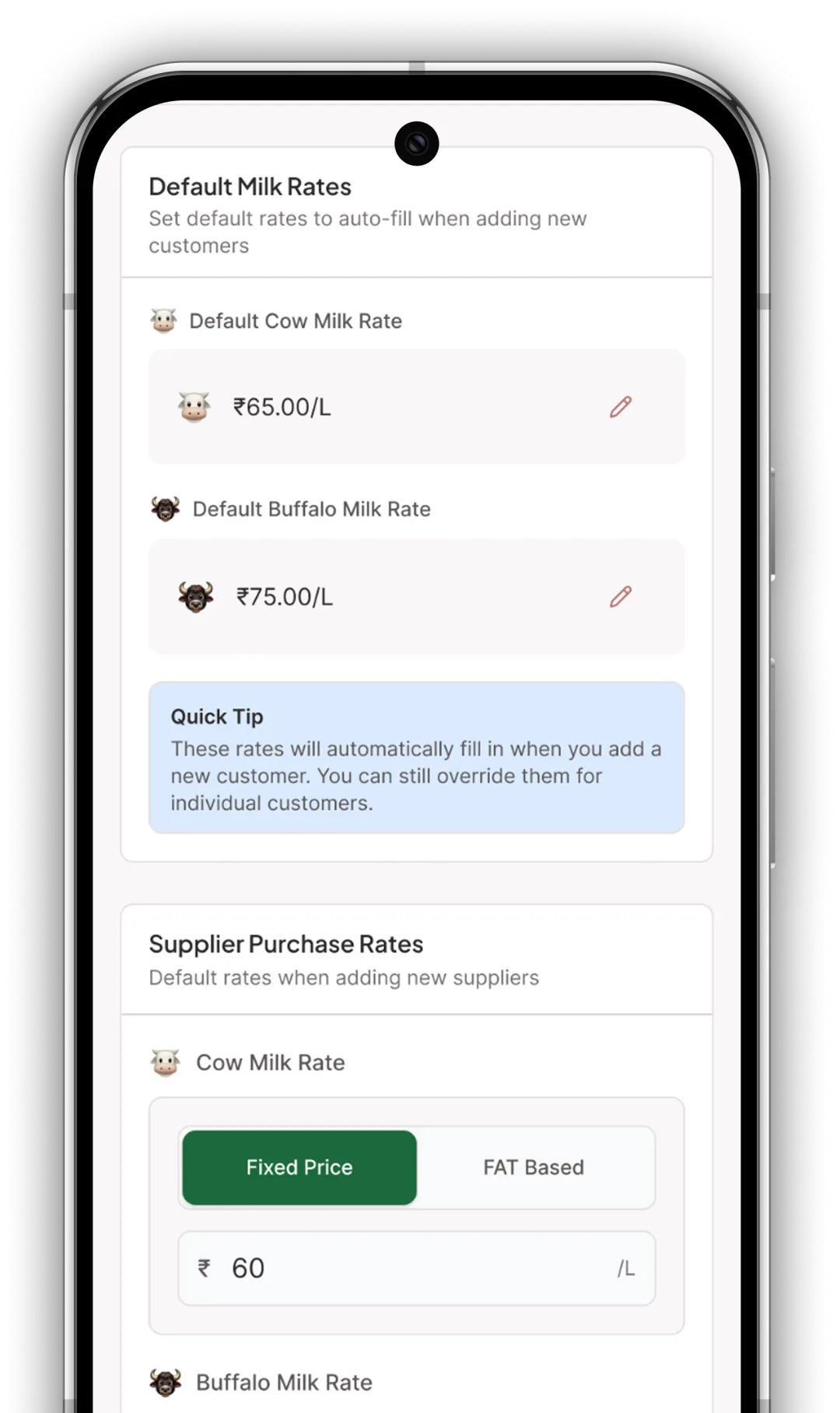
- Fixed-rate mode — set ₹X per litre. Simple and done.
- FAT-based mode — set the rate per FAT unit. At each delivery you enter the FAT%, and the app instantly calculates the rate per litre.
It records every day's FAT reading, works out what you owe automatically, and produces a clean monthly report for each supplier — average FAT, total litres and the exact amount due. No calculation mistakes, no rate arguments, every entry saved and transparent.
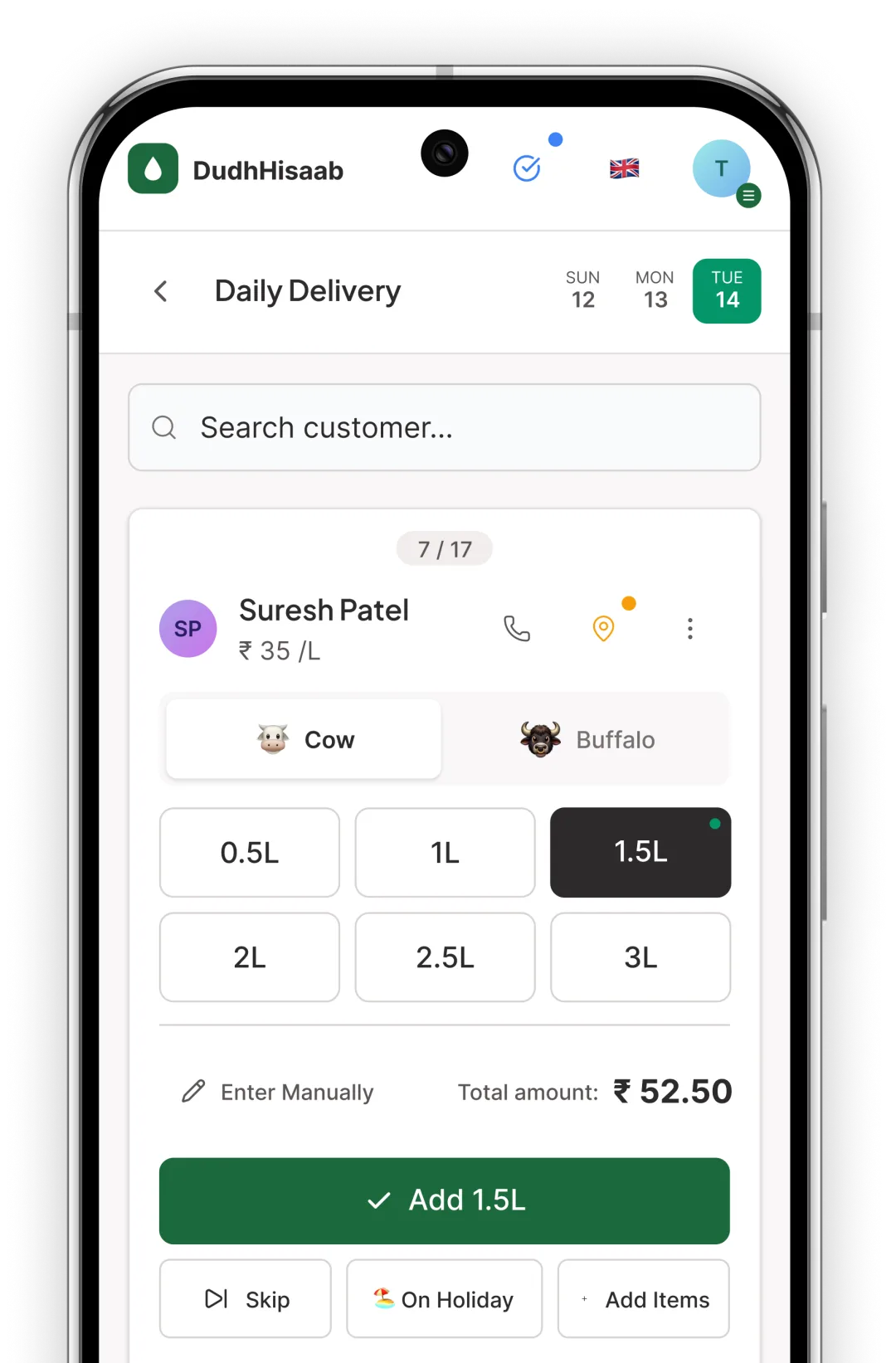
And it isn't only FAT. The same app keeps your customers, suppliers, daily deliveries, payments, monthly bills, WhatsApp reminders and business reports in one place — so the whole dairy runs from one screen instead of a drawer full of khatas and a calculator. That is the real point: not one more single-purpose tool, but the one app that does the lot. Browse everything it does, or see how dairies use their own numbers to grow the business.
Run your whole dairy from your phone. Customers, suppliers, daily entries, FAT-based rates, monthly bills and payment reminders — all in one free app. Get DudhHisaab on Google Play →
Key Takeaways
- FAT and SNF are the two quality parameters that set the milk price.
- FAT-based pricing is the simplest: Rate = FAT% × Rate per unit.
- Two-axis pricing (FAT + SNF) is the fairest for buyer and seller alike.
- Invest in basic testing gear — even a ₹200 lactometer catches quality problems.
- Record FAT and calculate payments with a digital tool, so a busy morning never costs you money.
Sources and Further Reading
- National Dairy Development Board (NDDB) — the Anand-pattern cooperative model and two-axis FAT + SNF procurement pricing. nddb.coop
- Richmond's formula — the standard method for deriving SNF from a lactometer reading, used across Indian dairies.
- Gerber method — the reference laboratory test for milk fat at collection centres.
- Bureau of Indian Standards (BIS) — IS 1183 covers lactometers and hydrometers; IS 1479 covers methods of test for milk.
Written and maintained by the DudhHisaab editorial team. The formulas and worked examples follow standard Indian dairy cooperative practice; actual rates vary by union and season. Last reviewed 6 June 2026.
New to the trade? Start with our complete guide to running a dairy business in India. Ready to stop calculating by hand? Download DudhHisaab free on Google Play — or open the web app on any device.
Manage your dairy business with DudhHisaab
Track customers and suppliers, record daily entries, auto-calculate FAT-based rates and monthly bills, and send payment reminders — all free in the app.