
The Khata Book: A Milkman's Most Important Tool
Every doodhwala in India knows the khata. That worn notebook — sometimes a proper register, sometimes a school copy — where you write each customer's name, daily milk delivery, and payment received. Your father used one. His father used one. The khata book has been the backbone of India's dairy micro-economy for generations.
But here's the question more and more milkmen are asking in 2026: Is the paper khata still the best tool, or is there a better way?
Let's compare honestly — paper khata vs digital app — across every dimension that matters to a working doodhwala.
Speed: How Fast Can You Record?
Paper Khata
- Open register, find today's page
- Find customer's name in the column
- Write quantity with pen
- Move to next customer
- Time per entry: 15-20 seconds (assuming you have the register handy)
- Time for 60 customers: 15-20 minutes
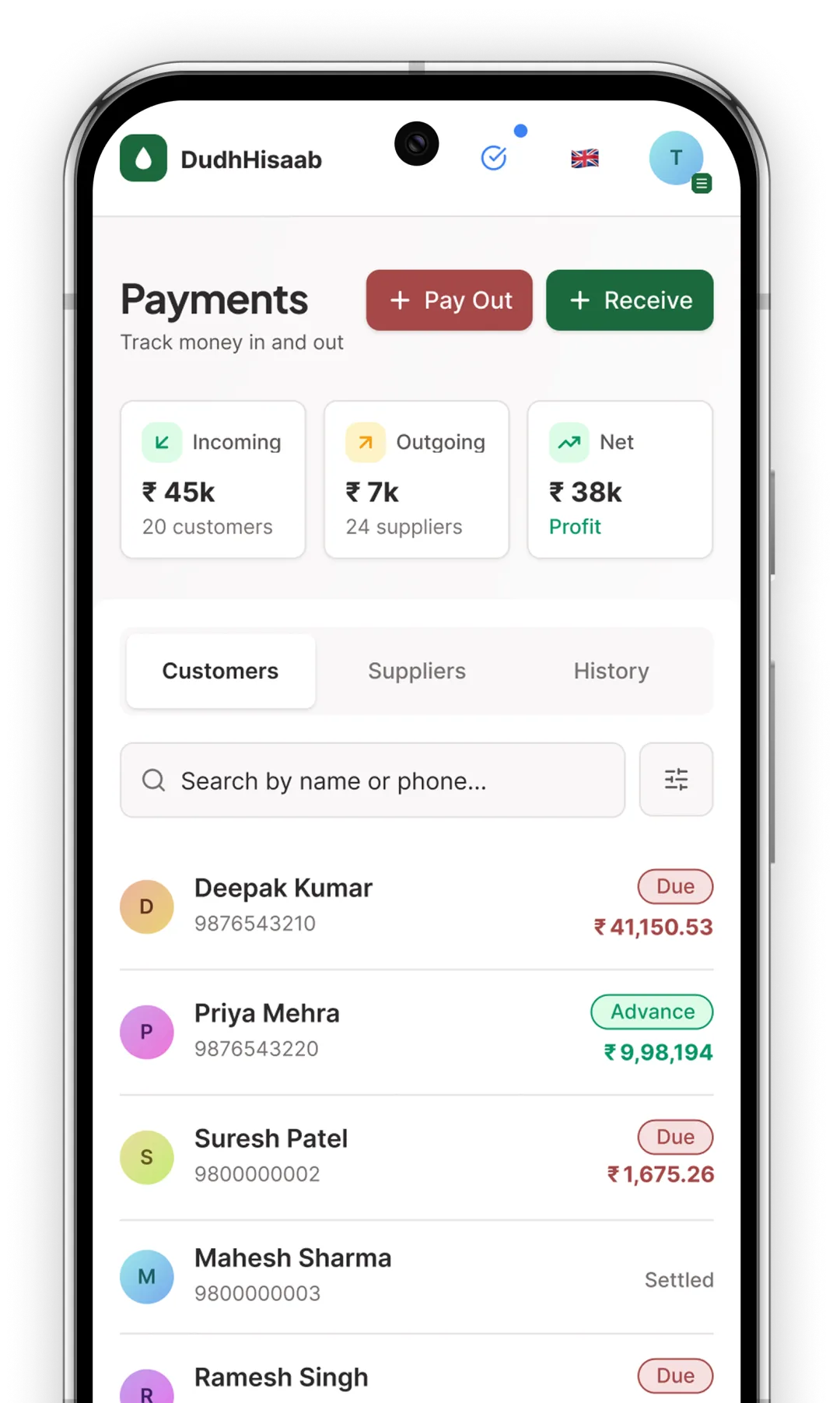
Digital App (Dudh Hisaab)
- Open app (already on home screen)
- Customer list is sorted by route
- Tap customer, enter quantity, save
- Time per entry: 3-5 seconds
- Time for 60 customers: 3-5 minutes
Winner: Digital app — saves you 15 minutes every morning. That's 7.5 hours per month.
But here's what matters more: you can record on the digital app while on your route. One hand holds the milk can, the other taps your phone. With a paper khata, you need both hands, a flat surface, and a pen — so most milkmen do it later from memory, which leads to errors.
Accuracy: How Reliable Are the Records?
Paper Khata
- Addition errors in monthly totals (very common — try adding 30 rows of varying numbers by hand)
- Illegible handwriting after months of use
- Entries in wrong columns (especially when you're sleepy at 5 AM)
- Overwriting and corrections create confusion
- "Did I write 1 or 1.5?" — ambiguous entries
Digital App
- Auto-calculation of daily, weekly, and monthly totals — zero math errors
- Every entry is timestamped and clear
- Can't accidentally write in the wrong customer's column
- Edit history is maintained — every change is logged
Winner: Digital app — by a wide margin. A single addition error on paper can cost you ₹500-2,000 per month per customer.
Durability: What Happens When Things Go Wrong?
Paper Khata
- Gets wet in rain (and milkmen are out in all weather)
- Pages tear, ink smudges
- Can be lost, stolen, or destroyed in an accident
- Termites and moisture damage over time
- Once lost, data is gone forever — no backup
Digital App
- Data synced to cloud — safe even if phone is lost
- Works on any new phone with your login
- Can work offline and sync later
- No weather damage
- Data backed up automatically every day
Winner: Digital app — we've heard from milkmen who lost years of records when their khata got soaked in monsoon rain. With an app, that scenario is impossible.
Monthly Billing: Generating Customer Statements
Paper Khata
- Sit down with calculator or do manual addition
- Add 28-31 rows of daily quantities for each customer
- Multiply by rate
- Subtract any payments received
- Write the total on a slip or tell the customer verbally
- Time for 60 customers: 2-4 hours of calculation
- High chance of errors
Digital App
- Open the app
- Tap "Generate Statement"
- Auto-calculated bill with every daily entry, rate, total litres, total amount, payments, and balance
- Send via WhatsApp in one tap
- Time for 60 customers: 5-10 minutes
- Zero calculation errors
Winner: Digital app — this alone saves 2-3 hours of tedious work every month, plus eliminates billing disputes.
Customer Disputes: Who's Right?
This is the big one. The most stressful part of being a doodhwala isn't the 4 AM wake-up — it's the arguments:
"Maine toh doodh nahi mangwaya tha us din" (I didn't order milk that day)
"Maine paise de diye the" (I already paid)
"Rate toh ₹55 tay hua tha, ₹60 nahi" (We agreed on ₹55, not ₹60)
Paper Khata
- You show your register. Customer says "that's your writing, how do I know it's correct?"
- No proof of what was delivered to their door
- No timestamp on payment entries
- Customer's word vs your word — awkward and damaging to the relationship
Digital App
- Every entry has date, time, and quantity — timestamped by the system
- Payment records show exact date and amount
- Customer can receive their own copy via WhatsApp
- Rate is set in the system — no ambiguity
- "Yeh dekho aapka statement" — show the phone, dispute over
Winner: Digital app — by an enormous margin. Digital records carry more credibility, and when both parties have a copy, disputes virtually disappear.
Cost Comparison
Paper Khata
- Register/notebook: ₹50-100 every 2-3 months
- Pen: ₹10-20
- Calculator: ₹100 (one-time)
- Total annual cost: ₹300-500
- Hidden cost: Time spent (4+ hours/month x 12 = 48+ hours/year on manual work)
Digital App
- Dudh Hisaab: Free forever for basic features
- Smartphone: You already have one (required for UPI, WhatsApp)
- Internet: You already pay for this
- Total additional cost: ₹0
- Hidden saving: 40+ hours/year in time, ₹50,000-2,00,000/year in avoided errors and faster collections
Winner: Digital app — it costs nothing extra and saves massive time and money.
"But I'm Not Good with Technology"
This is the most common objection, and it's completely valid. Many doodhwalas are 40-60 years old, didn't grow up with smartphones, and feel intimidated by apps.
Here's what we've observed with Dudh Hisaab users:
- Day 1-3: Feels unfamiliar, takes a bit longer than paper
- Day 4-7: Getting comfortable, starts feeling natural
- Week 2: Faster than paper, wouldn't go back
- Month 2: Wonders how they ever managed with paper
The key is that a dairy app designed for Indian milkmen (like Dudh Hisaab) is deliberately simple:
- Hindi + English interface
- Big buttons designed for rough working hands
- Minimal screens — you're never more than 2 taps from any function
- Works offline — no internet needed during your route
- WhatsApp support — stuck? Send us a message, we'll help in Hindi
If you can use WhatsApp (and 95% of milkmen already do), you can use Dudh Hisaab. It's simpler than WhatsApp.
What About Customers Who Want Paper?
Some traditional customers might say, "Mujhe kaaghaz pe likha hua dikhao" (Show me on paper). No problem — you can:
- Show them the statement on your phone screen
- Send the PDF bill via WhatsApp (most customers have it)
- Print a monthly statement if needed (any cyber cafe can do this for ₹5)
In practice, once customers see the professional, itemized digital statement, they prefer it. It looks more legitimate and is easier to read than handwritten entries.
The Verdict
| Feature | Paper Khata | Digital App |
|---|---|---|
| Recording speed | 15-20 min/day | 3-5 min/day |
| Calculation accuracy | Error-prone | 100% accurate |
| Durability | Fragile | Cloud-backed |
| Monthly billing | 2-4 hours | 5-10 minutes |
| Dispute resolution | Weak | Strong evidence |
| Cost | ₹300-500/year | Free |
| Customer impression | Traditional | Professional |
| Learning curve | None | 3-7 days |
The paper khata served Indian doodhwalas well for decades. But in 2026, when you already carry a smartphone, already use WhatsApp, and already accept UPI payments — switching to a digital hisaab app is the natural next step.
You don't need to throw away your paper register on day one. Many of our users ran both systems in parallel for the first month. But within 2-3 weeks, every single one stopped using paper.
Try Dudh Hisaab free — switch from paper in 5 minutes.