
The Payment Problem Every Milkman Knows
Ask any doodhwala what their biggest headache is, and the answer is almost always the same: "Paisa wapas lena" — collecting payments. You deliver milk every single day, rain or shine, at 5 AM. But when it's time to collect the monthly hisaab, suddenly customers are "not home," "will pay next week," or — worst of all — "I already paid."
After talking to hundreds of milkmen across India, we've identified the five most common payment mistakes that cost dairy businesses lakhs of rupees every year. The good news? Every single one is avoidable.
Mistake #1: Not Recording Deliveries on the Same Day
The problem: You deliver milk to 60 customers every morning between 5:30 and 7:30 AM. You think, "I'll write it all down in my khata tonight." But by evening, you can't remember — did Mrs. Sharma in B-204 take 1 litre or 1.5 litres today? Was Mr. Patel's order cancelled because he was travelling?
Over a month, these small gaps add up. You might under-bill some customers (losing revenue) or over-bill others (causing disputes).
The solution: Record every delivery immediately. In the old days, this meant carrying a khata book during your route — impractical when you're handling milk cans on a two-wheeler. With a smartphone app like Dudh Hisaab, you can record a delivery in 3 seconds: open the app, tap the customer, enter quantity, done. Do it right after you place the milk at the customer's door.
Cost of this mistake: Even ₹5 of unrecorded milk per day across 60 customers = ₹300/day = ₹9,000/month lost revenue.
Mistake #2: Not Setting Clear Payment Terms from Day One
The problem: A new customer starts taking milk. You're happy to have the business. Neither of you discusses when payment is due, how much advance to keep, or what happens if payment is late. Two months later, the customer owes ₹4,000 and keeps saying "kal deta hoon" (I'll pay tomorrow).
The solution: Before you start delivering to any new customer, clearly agree on:
- Rate per litre (for each milk type — gaay, bhains)
- Payment cycle: Monthly (1st to 30th), weekly, or fortnightly
- Payment due date: "Payment due by 5th of next month"
- Payment method: Cash, UPI (GPay, PhonePe), or bank transfer
- Advance deposit: Many experienced doodhwalas keep ₹500-1,000 advance. This protects you if a customer suddenly moves without paying.
Write these terms in your customer notes in Dudh Hisaab. When payment is due, the app reminds you and the customer has no room for confusion.
Mistake #3: Relying on Memory for Payment Tracking
The problem: Customer pays ₹2,000 on the 15th. You're on your route, both hands holding milk cans. You tell yourself, "I'll note it when I get home." Three customers later, another person pays ₹1,500. By evening, you're confused — was it ₹2,000 from Mrs. Gupta or Mrs. Verma?
Or worse: a customer says, "Maine already ₹3,000 diya tha pichle hafte" (I already paid ₹3,000 last week). You have no record. You can't prove otherwise. You either accept the claim (losing money) or argue (losing the customer).
The solution: Record payments the moment you receive them. If a customer gives you cash, open your app and mark it immediately. If they pay via UPI, the transaction is automatically timestamped — but still record it in your dairy app so you have one complete hisaab in one place.
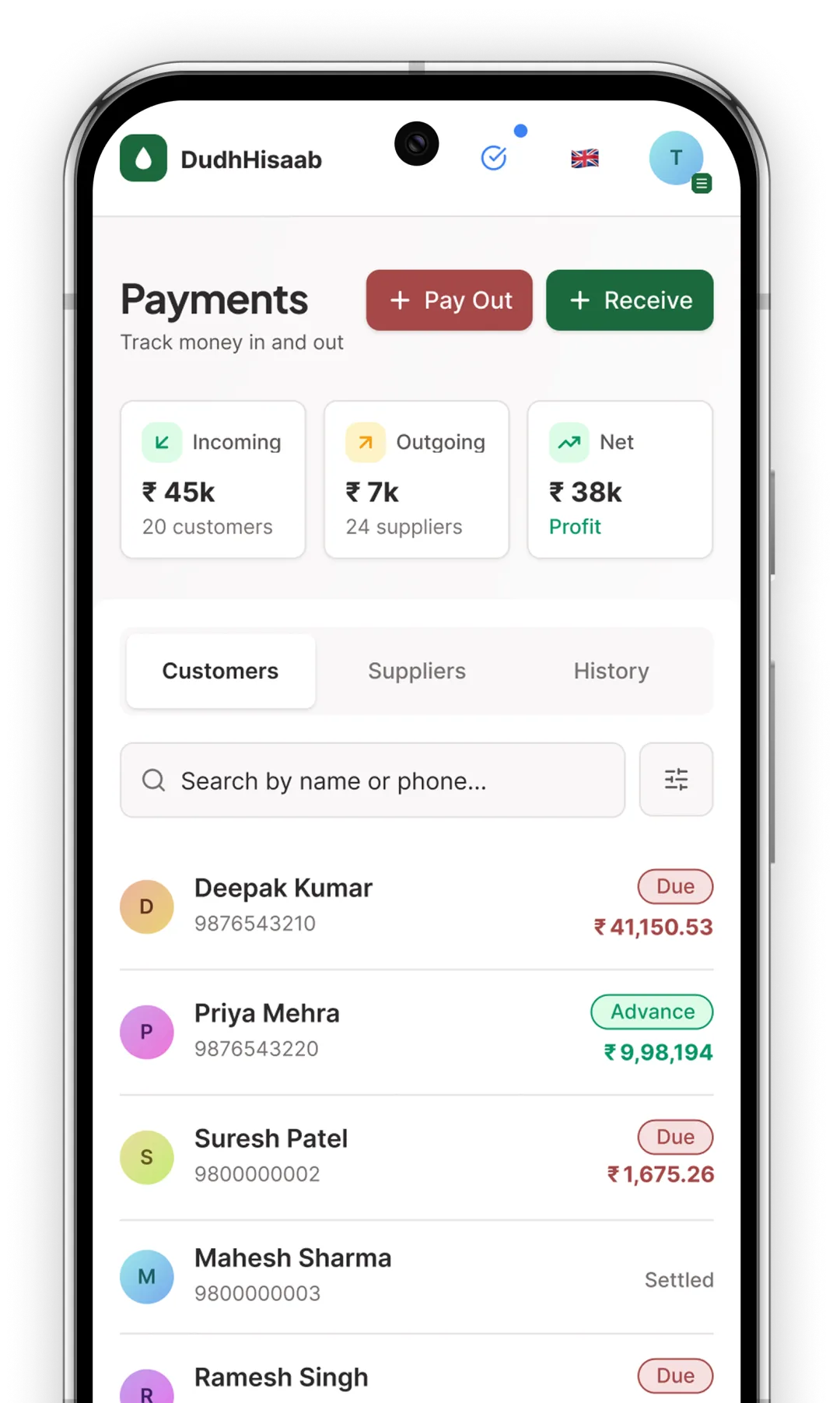
Dudh Hisaab shows each customer's complete payment history: date, amount, method, and running balance. If a customer claims they paid, you can show them the exact record on your phone. No arguments, no confusion.
Cost of this mistake: One disputed payment of ₹3,000 per month = ₹36,000/year — and that's a conservative estimate.
Mistake #4: Not Sending Monthly Bills or Statements
The problem: At month-end, you visit each customer and verbally tell them their total. "Aapka ₹3,420 hua hai" (Your total is ₹3,420). The customer says, "Itna kaise? Mujhe toh ₹2,800 lagta hai" (How is it this much? I think it's ₹2,800). Now you're standing at their doorstep doing mental math, trying to justify every entry.
The solution: Send a clear, itemized monthly statement to every customer before collecting payment. The statement should show:
- Each day's delivery (date, quantity, rate)
- Any missed days or holidays
- Total litres delivered
- Total amount due
- Previous balance and payments made
- Net amount payable
When a customer receives this statement — ideally a day before you come to collect — they've already reviewed it. Most disputes disappear because the evidence is right there.
Dudh Hisaab can generate and send these statements via WhatsApp with one tap. Each customer gets their personalized bill, formatted professionally with your business name.
Mistake #5: No Escalation Plan for Late Payments
The problem: A customer hasn't paid for two months. Total due: ₹6,800. You keep delivering because you don't want to "lose the customer." Three months pass. Now they owe ₹10,200. Finally, they tell you they're switching to packet milk. You never recover the money.
This is the most expensive mistake. One defaulting customer can wipe out the profit from 5-10 good customers.
The solution: Create a simple escalation process:
| Days Overdue | Action |
|---|---|
| 1-5 days | Friendly reminder via WhatsApp: "Aapka ₹X payment due hai" |
| 5-10 days | Follow up in person during morning delivery |
| 10-15 days | Send formal statement with overdue notice |
| 15-20 days | Reduce delivery quantity to half (with notice) |
| 20-30 days | Stop delivery until past dues are cleared |
| 30+ days | Consider it a loss, never deliver on credit again |
The key is to follow this consistently, not emotionally. When a customer sees you're serious about payment discipline, they prioritize you.
Dudh Hisaab highlights overdue customers in red on your dashboard. You can see at a glance who owes you money and for how long. Payment reminders can be sent via WhatsApp directly from the app.
Bonus: The Power of Digital Payments
We strongly encourage all doodhwalas to accept UPI payments (GPay, PhonePe, Paytm). Here's why:
- Instant record: Every UPI payment is automatically tracked by both banks. No disputes possible.
- No change problems: You don't need to carry ₹10 and ₹20 notes for change at 6 AM.
- Faster collection: Customers can pay from bed while you're delivering. No waiting for them to wake up.
- Tax benefit: Digital receipts qualify for lower presumptive tax (6% vs 8% of turnover).
- Professional image: Customers take you more seriously as a business.
Print a small QR code for your UPI ID and paste it on your milk can. Ask customers to scan and pay.
Summary: Protect Your Paisa
| Mistake | Monthly Cost | Fix |
|---|---|---|
| Not recording daily | ₹5,000-9,000 | Record in app immediately |
| No payment terms | Disputes | Set terms on day one |
| Memory-based tracking | ₹1,000-3,000 | Digital payment records |
| No monthly statements | Disputes, delays | WhatsApp statements |
| No escalation plan | ₹3,000-10,000 | Strict collection process |
These five mistakes combined can cost a typical doodhwala ₹15,000-30,000 per month. That's ₹1.8-3.6 lakhs per year — money that's rightfully yours.
Start tracking payments digitally — Dudh Hisaab is free.Related Guides
Fixing your payment habits is one piece of running a tight dairy business. If collecting from defaulting customers is your biggest headache, these payment collection tips for milkmen go deeper, and you can ditch memory-based tracking entirely by moving from a notebook to an app — see digital vs paper khata. Sending a clean bill before you collect (Mistake #4) is far easier when statements go out automatically every month, and giving each customer their own account to check their dues ends most "maine toh paisa de diya tha" arguments before they start. Want to do the month-end math without a calculator at the doorstep? Try the free milk receipt generator to print a professional, itemised bill in seconds.