
Most milkmen start with a simple dream: "I'll deliver milk to 50 families and make ₹40,000 a month." Six months in, they hit 30 customers and stall. A year in, they're still at 40. The business feels stuck even though demand is all around them.
This isn't a customer problem — it's a systems problem. The jump from 20 to 200 customers is not about working harder. It's about building the right systems, making the right hires, and using the right tools. This guide is the exact playbook we have seen work for hundreds of Indian doodhwalas.
1. Why Most Milkmen Stall at 50 Customers
If you have been running a milk delivery business for more than 6 months, you have probably felt "the wall". Every new customer feels like an old customer is leaving. Your profit never crosses ₹35,000-40,000 no matter how hard you work. Here is what is actually happening:
| Stall Reason | What It Looks Like | Real Cause |
|---|---|---|
| "I don't have time to find new customers" | Days blur into deliveries and collections | No system for referrals/marketing |
| "Paper khata is becoming a mess" | 3 days/month spent just on billing | Manual hisaab doesn't scale |
| "Can't find good delivery help" | Hiring 2-3 people who quit in 1 month | No training, no structure |
| "I lose 10-15% to payment delays" | ₹15,000 stuck every month | No automated bill reminders |
| "Quality complaints are rising" | 2-3 customers per week unhappy | No batch quality tracking |
| "My supplier disappoints during monsoon" | Supply gaps every rainy season | Single-supplier dependency |
Notice the pattern — every "stall" reason is actually a missing system. Scaling is not magic; it's the act of replacing manual effort with repeatable processes.
2. The Systems You Need BEFORE You Scale
Before you spend a single rupee trying to get more customers, fix these six foundations. Skipping them is the #1 reason milkmen fail at scaling.
System 1: Digital Hisaab (Non-Negotiable)
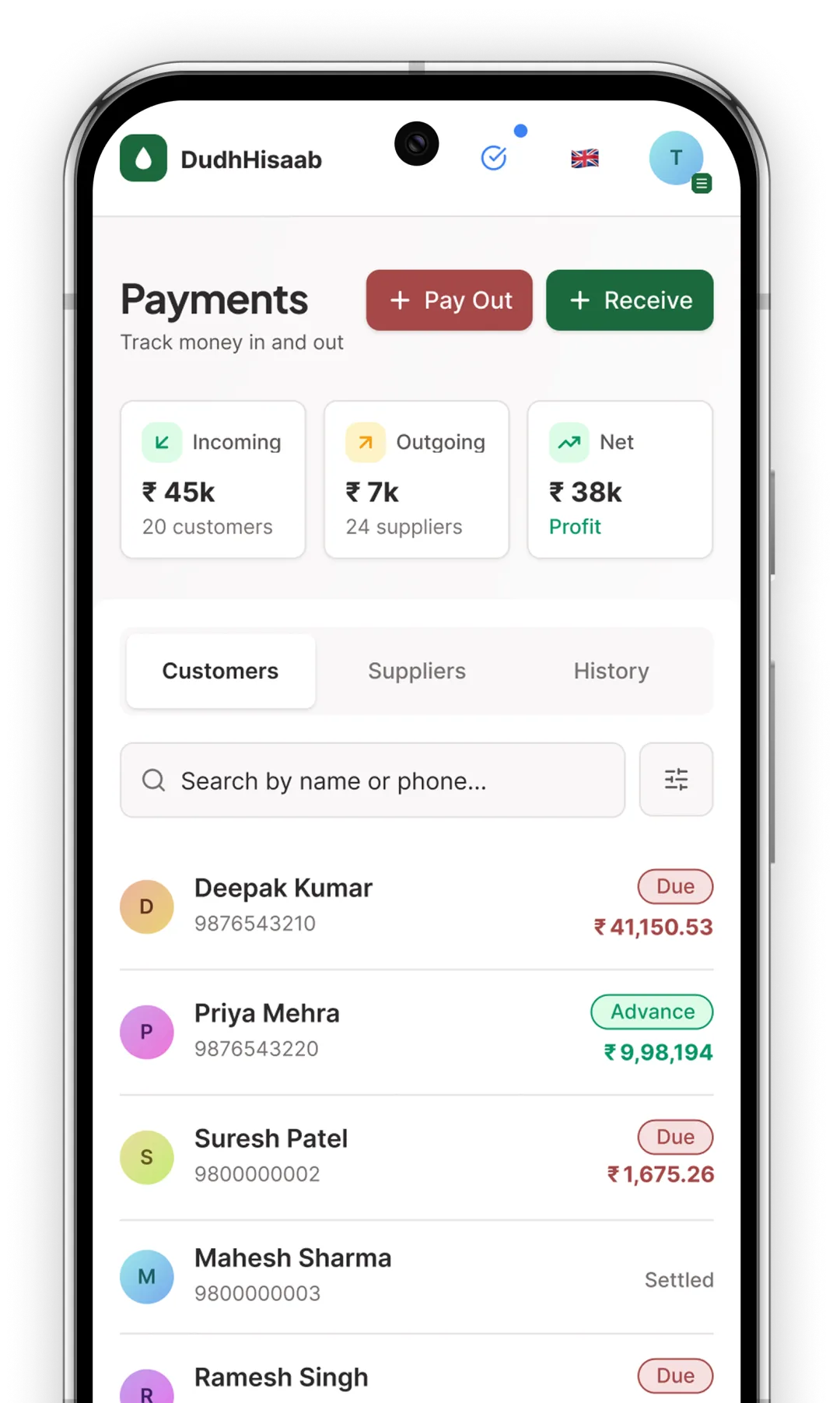
If you are still on paper at 30 customers, moving to 100 customers on paper will literally cost you your business. Switch to a dairy management app (we made Dudh Hisaab specifically for this). You need:
- Customer master with rate, delivery address, phone
- Daily entry in under 10 seconds per customer
- Auto-calculated monthly bills
- One-click WhatsApp bill sharing
- Payment tracking and pending dues dashboard
System 2: Standardised Pricing
At 20 customers you can remember every rate. At 80 customers you will make mistakes. Create a simple rate card:
- Cow milk — ₹60/L
- Buffalo milk — ₹85/L
- Mix — ₹72/L
- A2 premium — ₹110/L
No special deals, no "you're an old customer so ₹2 discount". Fair, transparent, public.
System 3: A Morning Route Sheet
Print or export a daily route sheet with: customer name → address → quantity → rate → expected amount. Your future delivery helpers will need this. Start using it yourself now.
System 4: Monthly Closing Ritual
Pick a fixed day (1st of every month). Do the same thing every time: send bills → record payments → identify pending → follow up → close books. If you have a ritual, it takes 2 hours. If you don't, it takes 3 days.
System 5: Customer Feedback Loop
Once a month, call or WhatsApp 10 customers randomly. Ask: "Kya doodh theek aa raha hai? Kuch problem hai kya?" This catches silent customers who are about to leave.
System 6: A Simple Backup Plan
What happens if you fall sick tomorrow? Who knows your route? Who has your app login? Write a 1-page "emergency doc" with all critical info, share it with a trusted family member.
Until you have these six systems, do not try to scale. You will burn money and energy.
3. Customer Acquisition Strategies That Actually Work
Now the fun part — getting new customers. Here are the only five strategies worth your time, in order of effectiveness.
Strategy 1: The Referral Loop (Highest ROI)
Every happy customer is sitting next to 5-10 potential customers. You just need to make it easy for them to refer.
Offer: "Refer a neighbour — you get ₹100 off your next bill, they get 2 days free milk."
Here's how to activate it:
- Print simple cards ("refer a friend, save ₹100") and give one to every customer during the monthly visit.
- Mention it in your monthly WhatsApp bill message: "Dost ko refer karein, aap ko ₹100 milenge."
- Whenever you get a new customer via referral, text both parties a thank-you.
Expected result: 15-30% of new customers every month, at zero marketing cost.
Strategy 2: Free Trial (Best for New Colonies)
Entering a new colony? Offer a 2-day free trial. Drop 200 ml of cow and 200 ml of buffalo milk at 50 doors on day one, same on day two, with a WhatsApp number on a sticker. Typical conversion: 15-25%.
Cost per acquired customer: ₹80-120. Lifetime value of a milk customer: ₹30,000-80,000. The math is absurdly good.
Strategy 3: Society WhatsApp Groups
Every apartment society has 3-5 WhatsApp groups. Find one member, offer free trial, and ask them to post a one-line review after 3 days: "Tried {your name}'s milk, quality is good, sharing his number." Do this in 5 societies and you will have 30 new customers in a month.
Strategy 4: Google My Business
Free. Takes 30 minutes to set up. Upload 5 photos of your dairy setup, your scooty, a customer handshake. When anyone searches "doodhwala near me", you show up. This is a long-term compounding asset — invest in it now.
Strategy 5: Quality Reputation
The cheapest and most powerful marketing is quality. One household with a newborn baby tells 20 households about the milkman whose milk they trust. Never cut corners on purity. One detergent-adulterated day can destroy 6 months of work.
Strategies to Avoid
- Price wars: Undercutting ₹10/L attracts the worst customers who leave at the slightest excuse.
- Paid Instagram ads: Almost no milkman has made these work. Save your money.
- Newspaper inserts: Low response rates, high cost.
- SMS blasts: Ignored by everyone.
4. Route Optimization and Delivery Logistics
When you have 30 customers, your route is whatever street you feel like. At 100 customers, a bad route will cost you 2 hours a day.
The 3-Colony Rule
Cluster your customers into no more than 3 distinct colonies. Expanding beyond 3 colonies in year one is the biggest mistake milkmen make — it looks like growth but destroys your efficiency.
Delivery Windows
| Time Slot | Customer Type | Why |
|---|---|---|
| 5:00-6:30 AM | Old families, housewives | Traditional "subah ki chai" customers |
| 6:30-8:00 AM | Working professionals | Before office rush |
| 8:00-9:00 AM | Tea stalls, sweet shops | Commercial customers |
| 5:00-7:00 PM | Apartments needing evening milk | Younger families |
Plan your morning route to hit old-timer families first (they're awake), then working professionals (they're stepping out), then shops.
Route Math
A well-planned route should deliver to 35-50 customers per hour using a scooty. This means:
- 50 customers = 1 hour delivery
- 100 customers = 2-2.5 hours
- 150 customers = needs 2 routes OR 1 route + 1 helper
Use a simple Google Maps "Saved Places" list for your customer addresses. Reorder them in the optimal sequence once, and stick to it.
5. Hiring and Managing Delivery Workers
The biggest unlock for scaling is hiring your first helper. Most milkmen delay this because:
- "I can't afford a helper"
- "No one will be as careful as me"
- "It's too risky"
All three are wrong. Here is the reality.
When to Hire Your First Helper
When you cross 80 customers or find yourself delivering after 9 AM. Both signs mean your route is choking.
Payment Structures That Work
| Structure | Pros | Cons | Best For |
|---|---|---|---|
| Fixed salary (₹10,000-15,000/month) | Predictable, stable staff | No performance incentive | Urban delivery |
| Per-delivery commission (₹1-2 per customer) | Staff motivated to cover more | Risk of rushed deliveries | Semi-urban |
| Salary + bonus on retention | Balanced motivation | More complex to track | Medium-large routes |
Most successful milkmen in 2026 use the "salary + ₹500 retention bonus per month for zero customer complaints" model.
Training Your Helper
Day 1: Do the full route together. Show every customer. Explain special requests.
Day 2-3: Helper delivers, you follow on a separate scooty, correct mistakes live.
Day 4-7: Helper delivers alone, you check at 3-4 random customers each day.
Week 2: Full independence, weekly review calls.
Your goal: by day 10, the helper should be fully operational and you should be focused on growth.
Retention Tricks
- Pay on time, every time. No exceptions.
- Give a raise after 6 months, no matter what.
- Diwali gift + Holi gift (₹500-1000 each). Huge loyalty unlock.
- Respect. Never scream, never humiliate.
6. Technology Stack: From Paper Khata to Digital
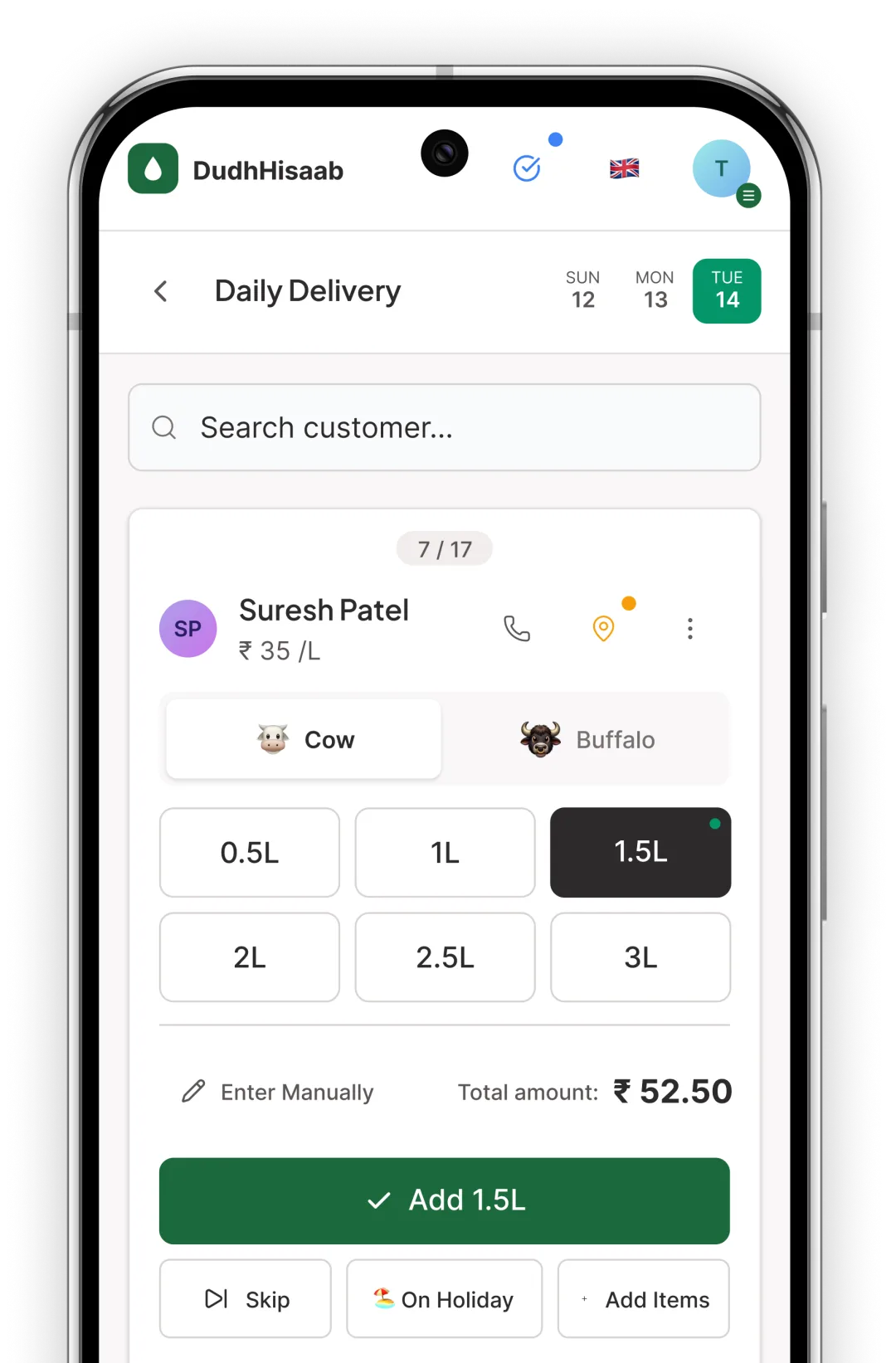
Here is the stack every milkman scaling past 100 customers should have:
| Tool | Purpose | Cost |
|---|---|---|
| Dudh Hisaab app | Daily entry, billing, reminders | Free |
| WhatsApp Business | Bill sharing, rate updates, complaints | Free |
| UPI (PhonePe/GPay) | Collection | Free |
| Google My Business | Local search visibility | Free |
| Google Drive | Photo backup of cans, receipts | Free |
| Google Maps Saved Places | Route planning | Free |
| Canva mobile | Simple flyers, rate cards | Free |
| Simple digital scale | Quantity accuracy | ₹1,500 |
| Basic FAT tester | Quality verification | ₹8,000-25,000 |
Notice how almost everything here is free. Technology isn't expensive — it just needs to be adopted intentionally.
7. Cash Flow Management at Scale
At 30 customers, cash flow is simple: what comes in is what you keep. At 150 customers, you are running a small enterprise, and bad cash flow can kill you even with profits on paper.
The Three-Bucket System
Split your monthly income into three buckets the moment it comes in:
- Bucket 1 (70%): Operating — supplier payments, fuel, helper salary, phone
- Bucket 2 (20%): Reinvestment — one new asset per quarter (scooty upgrade, second helper, marketing)
- Bucket 3 (10%): Emergency — touch only for genuine emergencies (cattle disease, vehicle breakdown, medical)
The 15-Day Collection Rule
Your target: collect 90% of monthly bills within 15 days of month-end. The only way to achieve this:
- Send WhatsApp bill on day 1 of next month, not day 5 or day 10.
- Send reminder on day 5 if unpaid.
- Send reminder on day 10 with a clear due date of day 15.
- Visit in person on day 16 for anyone still unpaid.
- Stop supply on day 20 for persistent non-payers (warning them first).
This single discipline will free up ₹20,000-40,000 of stuck working capital every month for most milkmen.
Supplier Payment Timing
Pay your farmers/suppliers before your customers pay you. This builds massive loyalty with suppliers, who will prioritise you during shortages and give you better quality. Use a small float from your emergency bucket if needed in month 1.
8. Quality Control as Volume Grows
At 30 customers, you see every litre of milk yourself. At 150, you physically cannot. Here is how to scale quality.
Daily Batch Testing
Every morning, test a sample from every supplier for FAT, SNF, lactometer reading. Record it in your app or notebook. Discard any batch that fails.
Customer Feedback Dashboard
Maintain a simple list: for every complaint, log customer name + date + complaint + resolution. Review weekly. If any supplier is linked to 3+ complaints in a month, switch suppliers.
Random Audits
Once a week, ask a trusted customer to share a photo of the milk you delivered in a glass. Look for colour, thickness, foam. Compare with last week. This catches quality drift early.
Equipment Hygiene
Cans must be washed after every delivery round. Use food-grade sanitizer, not just soap. Dry under the sun whenever possible. A dirty can will ruin 10 litres of otherwise perfect milk.
9. Handling Complaints at Scale
You will get complaints. The question is whether you handle them like a person or like a professional.
The Universal Complaint Protocol
- Listen without defending: Never say "mera doodh toh hamesha theek hota hai" — even if it's true.
- Verify the batch: Check your records for that day's FAT and the supplier. Share this data.
- Refund or replace immediately: 1 free litre or ₹50-100 credit. Customer value is ₹30,000+, don't fight over ₹100.
- Document: Log in your complaints list. Look for patterns.
- Follow up in 3 days: "Sab theek hai ab?" — this single message retains 80% of complaining customers.
Handling "Kal Doonga" (Payment Delays)
Never shame. Never threaten. Simply say: "Bhaisaab, mahine ke 15 tak mujhe supplier ko bhi paise dene hain, toh aap agar aaj UPI kar dein toh badi madad ho jaayegi." Most people pay within the hour.
Learn more: Full customer conflict playbook in handling customer complaints in dairy business.
10. Expansion: Adding Products (Ghee, Paneer, Dahi)
Once you hit 100 customers, you have a captive audience. Selling them more from the same delivery route is the easiest revenue boost you will ever get.
The Natural Extensions
| Product | Margin | Complexity | Good First Step? |
|---|---|---|---|
| Dahi (curd) | 40-50% | Low | Yes — start here |
| Paneer | 35-45% | Medium | Yes — after 3 months |
| Ghee | 50-60% | Medium | Great for festivals |
| Chaach (buttermilk) | 60-70% | Low | Great in summer |
| Khoa / Mawa | 45-55% | High | Only if local demand |
| Butter | 35-45% | Medium | Niche customers |
| Flavoured milk | 40-60% | Medium | Summer boost |
The "Offer of the Week" Play
Every Monday, send a WhatsApp broadcast: "Is hafte ka special — fresh desi ghee ₹550/kg, order by Wednesday for Friday delivery." This creates predictable product sales without overwhelming your operations.
Expected impact: 15-25% bump in monthly revenue from the same customer base.
Product Pricing Rule
Price products to match the big organised brands (Amul, Mother Dairy) but promise fresher and home-delivered. Do not undercut — positioning matters.
11. Geographic Expansion
Once you have saturated your 3 colonies (75%+ household penetration), geographic expansion becomes the next growth lever. Do it carefully.
Rule 1: Contiguous Only
New areas should be adjacent to your existing routes. Skipping across the city means 2 extra hours of travel. Always.
Rule 2: One Colony at a Time
Pick one new colony per quarter. Attack it with free trials for a full month, convert 30-50 customers, stabilise operations, then move to the next.
Rule 3: Dedicated Staff
Never expand into a new area on your existing helper's already-full route. Hire a new helper for the new colony. Let them own it.
Rule 4: Track Unit Economics Separately
Know the profit of each colony independently. If one colony is dragging your margins, it needs attention — either more customers, better pricing, or an exit plan.
12. Real Case Study: Rajesh Sharma, Bhopal — 30 to 200 Customers in 18 Months
Rajesh started in January 2024 with 30 customers in one Bhopal colony. He was earning ₹24,000/month but working 14-hour days. By July 2025, he had 200 customers across 3 colonies, a helper, and a monthly net profit of ₹1.05 lakh. Here is exactly what he did.
Months 1-3 (30 → 45 customers)
- Switched from paper to Dudh Hisaab app
- Started a referral scheme: ₹100 credit per referral
- Paid suppliers on time, built goodwill
- Outcome: 15 new customers, zero late payments
Months 4-6 (45 → 75 customers)
- Did a free 2-day trial campaign in the next colony
- Set up Google My Business with 5 photos
- Bought a better scooty (used, ₹35,000) for faster route
- Outcome: 30 new customers, delivery time stable at 2.5 hours
Months 7-9 (75 → 110 customers)
- Hired first helper at ₹11,000/month + ₹500 retention bonus
- Split route into morning cow milk + morning buffalo milk
- Started weekly paneer sales on Wednesdays
- Outcome: 35 new customers, first "scaled" profit month at ₹48,000
Months 10-12 (110 → 150 customers)
- Added a third colony, 1 hour away
- Switched 40% of customers to UPI payment (collection time dropped from 18 days to 6 days)
- Introduced a ₹2/L loyalty discount for customers over 12 months
- Outcome: 40 new customers, fewer payment disputes, profit ₹75,000/month
Months 13-15 (150 → 180 customers)
- Hired second helper, dedicated to new colony
- Launched festival ghee packs for Diwali — ₹38,000 in extra revenue that month
- Started monthly feedback calls to catch silent leavers
- Outcome: 30 new customers, profit ₹88,000/month
Months 16-18 (180 → 200 customers)
- Added dahi and chaach to daily delivery
- Bought a used chest freezer for ₹9,000 (stored backup milk)
- Optimised route using Google Maps saved places
- Outcome: 20 new customers, profit ₹1.05 lakh/month, work day reduced to 10 hours
Key lessons from Rajesh's journey:
- Digital hisaab from day one freed up the time to grow.
- He never chased price wars. He held his ₹62/L cow milk and won on quality.
- He reinvested 30% of every profit month into the next growth step.
- He hired helpers BEFORE he was drowning — not after.
- He treated every complaint as a gift.
13. Financial Progression: What Scaling Actually Looks Like
Here is the real financial progression Rajesh experienced during his 18-month scale-up. Understanding these numbers will help you set realistic expectations for your own scaling journey:
| Month | Customers | Gross Revenue | Milk Cost | Other Costs | Net Profit |
|---|---|---|---|---|---|
| 1 | 30 | ₹58,500 | ₹33,000 | ₹1,500 | ₹24,000 |
| 3 | 45 | ₹87,750 | ₹49,500 | ₹3,250 | ₹35,000 |
| 6 | 75 | ₹1,46,250 | ₹82,500 | ₹5,750 | ₹58,000 |
| 9 | 110 | ₹2,14,500 | ₹1,21,000 | ₹23,500 | ₹70,000 |
| 12 | 150 | ₹2,92,500 | ₹1,65,000 | ₹42,500 | ₹85,000 |
| 15 | 180 | ₹3,51,000 | ₹1,98,000 | ₹65,000 | ₹88,000 |
| 18 | 200 | ₹3,90,000 | ₹2,20,000 | ₹65,000 | ₹1,05,000 |
Observations:
- Revenue grows linearly with customer count
- Net profit does not grow linearly — it dips in months 9-12 when helpers are hired, then compounds
- "Other Costs" include fuel, helper salary, phone, packaging, maintenance, festival bonuses
- The period from month 9 to 12 is the toughest. You are paying for helpers but not yet at optimal efficiency. Push through it — the rewards come in month 13+.
14. What NOT to Do When Scaling
Every failed scaling attempt we've seen has followed one of these patterns. Avoid them:
Anti-Pattern 1: Jumping to 3 Cities at Once
"I'll start home delivery in Indore, Bhopal, and Ujjain!" No. Pick one. Win one. Then expand.
Anti-Pattern 2: Competing on Price
Dropping your rate ₹10/L below the market attracts customers who will switch again at ₹12/L off. Low-price customers are the most expensive customers you can have.
Anti-Pattern 3: Hiring Relatives Without Pay Discipline
"Mera cousin mera helper banega, paise baad mein dekh lenge." Two months later, pay disputes destroy family AND business. Pay everyone — including family — on time, every time.
Anti-Pattern 4: Ignoring Customer Feedback
If 3 customers in a week complain about thin milk, it is not a coincidence. Investigate immediately. Don't defend, investigate.
Anti-Pattern 5: Over-Investing in Cosmetics Before Systems
Fancy printed cans and designer T-shirts don't add a single customer. Clean milk and reliable delivery do. Spend on systems before aesthetics.
Anti-Pattern 6: Refusing to Switch Technology
We've met milkmen in 2026 still on paper khatas at 120 customers, losing ₹20,000-30,000 a month to disputes and missed collections — but "I'm used to paper". Your comfort is costing you more than the app ever could.
Final Thoughts
Scaling from 20 to 200 customers is not about being more talented or hustling harder. It is about putting the right systems in place, hiring at the right time, keeping quality relentlessly consistent, and reinvesting profits into growth instead of lifestyle upgrades.
Every successful milkman who scaled did so with the same three moves:
- Move 1: Switched to digital hisaab before crossing 50 customers
- Move 2: Hired their first helper before crossing 100 customers
- Move 3: Added a second product before crossing 150 customers
Do these three things in order, and the customer count will take care of itself. The milkmen who are making ₹1-2 lakh per month in 2026 are not working twice as hard as those making ₹30,000. They made three smart decisions early and let those compounds over 18-24 months.
Ready to make Move 1 right now? Download Dudh Hisaab free and set up your entire customer base, rates, and monthly billing in under 30 minutes. No card needed. Made for milkmen, by a team that actually understands dairy.